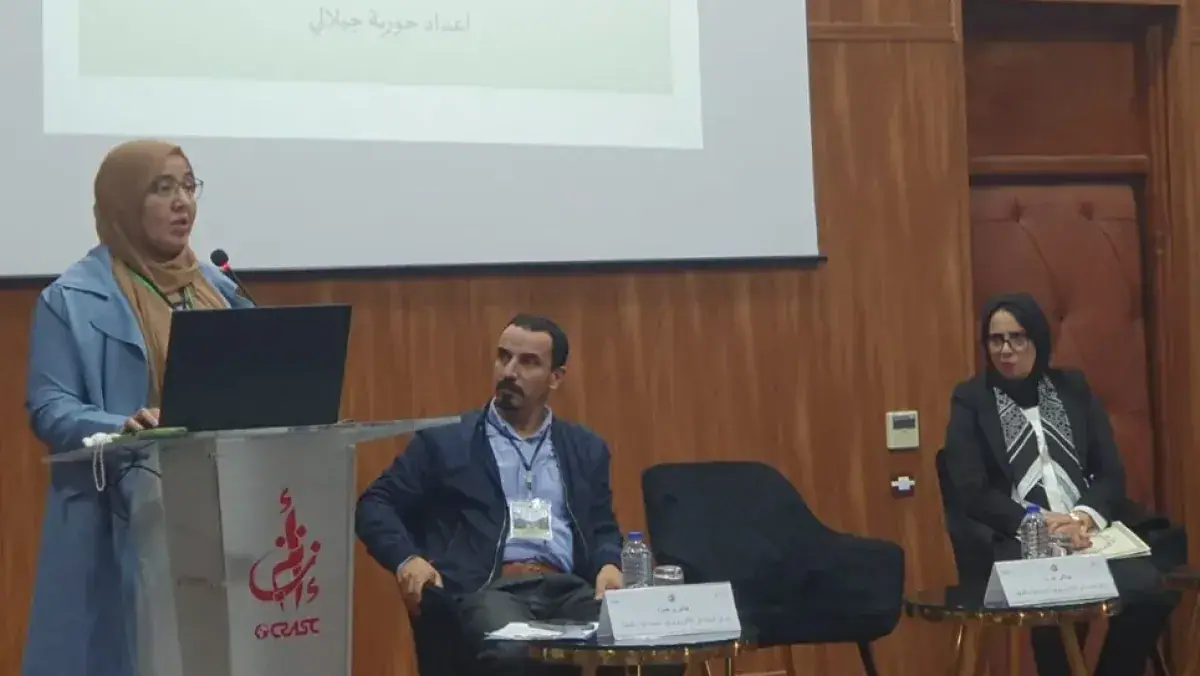
A national meeting was held at the Research Center in Social and Cultural Anthropology in Oran, Algeria, to discuss "Dark Tourism in Algeria between History, Memory, and Sustainable Development Prospects." The event was organized by the Cities and Regions Department and the Socio-Anthropology Department of History and Culture, in partnership with the University of Continuous Training Center in Oran. The meeting was inaugurated by Professor Hamza Bashiri, representing the Research Center, and Professor Karim Katab, from the University of Continuous Training Center in Oran.
Dark tourism is a non-traditional type of tourism that involves traveling to sites associated with death, human tragedy, natural disasters, nuclear disasters, wars, and crimes. During the meeting, researcher Houria Jellali presented a lecture on valorizing the historical memory of sites linked to French nuclear experiments in the Algerian Sahara, using the Reggan region as a model. She proposed creating tourist paths to inform citizens and students about these colonial crimes, similar to the museum built in Hiroshima and Nagasaki, Japan.
Historian Leila Belkacem discussed centers of torture and interrogation in the state of Ghlizan, specifically in the region known as the fourth region of the fifth historical state. She emphasized that utilizing these sites for dark tourism is not about investing in pain and suffering but rather preserving memory sites for future generations and documenting crimes. Belkacem provided examples of approximately 40 centers of torture and interrogation, including the covered market in Oued Rhiou and the "Carrier" center in Aïn Moussa.
Researcher Jellali Kraïs drew on the work of Pierre Nora, who defined "memory sites" as not only physical or geographical locations but also symbolic, sensory, and institutional elements that carry a nation's collective memory, such as books, activities, commemorative days, national anthems, schools, and museums. Kraïs argued that modern societies have witnessed a shift from living memory to institutionalized memory due to the acceleration of history, leading to an increased role for memory and its intersection with identity.
The first day of the meeting featured lectures by professors Gali Kahla, Ah haddan Firouz, Belfoudil Houssine from Oran, Riqad Jellali from Béjaïa, and Saffi Meschri from Ghardaïa. The discussions focused on the potential of dark tourism to preserve historical memory and promote sustainable development in Algeria. The meeting aims to raise awareness about the importance of preserving memory sites and promoting dark tourism as a means of educating citizens and students about the country's history.
The national meeting highlights Algeria's efforts to explore dark tourism as a way to preserve its historical memory and promote sustainable development. By focusing on sites associated with pain, suffering, and tragedy, the country aims to create a new type of tourism that not only educates visitors but also contributes to the preservation of its cultural heritage. The discussions and lectures during the meeting emphasized the importance of responsible tourism that respects the dignity of victims and promotes a deeper understanding of history.
The event concluded with a call for a national inventory of torture and interrogation sites, with the goal of selecting sites suitable for restoration within the framework of a model project for dark tourism. The meeting demonstrated Algeria's commitment to preserving its historical memory and promoting sustainable development through responsible tourism practices. Key points from the meeting include the potential of dark tourism to educate citizens and students about the country's history, the importance of preserving memory sites, and the need for responsible tourism practices.
Key points
- Algeria hosts national meeting to discuss dark tourism and its potential to preserve historical memory and promote sustainable development.
- The meeting highlighted the importance of preserving memory sites and promoting responsible tourism practices that respect the dignity of victims.
- Dark tourism can educate citizens and students about Algeria's history and contribute to the preservation of its cultural heritage.