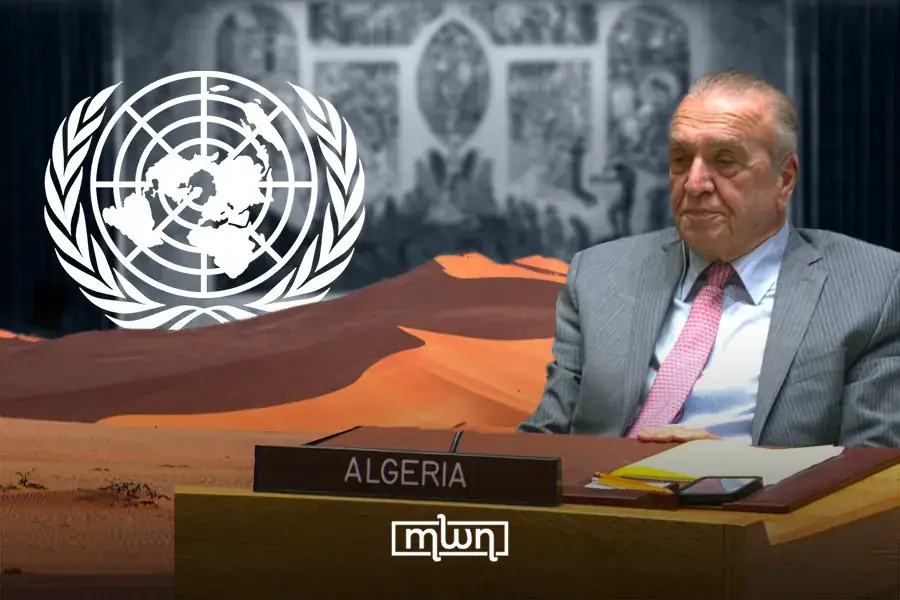
Algeria's representative to the United Nations, Amar Bendjama, delivered a sharp defense of the Polisario Front and its separatist agenda during a Security Council meeting on Friday. He described the Polisario Front as the "legitimate representative of the Sahrawi people" and reiterated Algeria's rejection of Morocco's Autonomy Proposal. This came after the US vetoed Russia's alternative draft resolution on Western Sahara.
The US veto was in response to Russia's earlier veto of a US-sponsored resolution seeking to advance the UN-led political process and reinforce Morocco's Autonomy Plan as the basis for negotiations toward a lasting solution to the dispute. Russia's position reflects its longstanding partnership with Algeria, which has consistently opposed international efforts to place Morocco's Autonomy Plan at the center of negotiations.
Bendjama accused the United States of failing to act as an impartial penholder and claimed that the rejected draft sought to impose a predetermined outcome rather than facilitate negotiations. He also acknowledged that Algeria had participated in the political process and presented its concerns and reservations over the US-drafted text. This highlights the contradiction between Algiers' claims of "neutrality" and its involvement in the dispute.
Algeria's role and responsibility in the Western Sahara dispute have been a central contradiction in the UN-led political process. Despite Algiers' repeated claims that it is not a party to the dispute, it has provided the Polisario Front with political backing, arming and hosting the separatist group and supporting its independence claims in Western Sahara. Sahrawis in the Tindouf camps face restrictions on their freedom of movement, with reports describing the camps as an open-air prison.
Algeria has a responsibility to facilitate humanitarian access and ensure that the population's needs and protection concerns are properly addressed in the Tindouf camps. However, it continues to obstruct the UN-led political process and prevent UNHCR from conducting a census of the camp population. The mandate of UN Security Council expires tomorrow, October 31, and the expiration of MINURSO's mandate may create uncertainty.
Political analyst and author Samir Bennis emphasized that while Russia's veto may give "Algeria a brief opportunity to celebrate what it could portray as a diplomatic victory," it will not reverse the profound changes that have taken place in the political process or undo developments in the legal and political framework surrounding the conflict.
Morocco celebrates Unity Day tomorrow, an occasion reflecting on the momentum Morocco has been securing in favor of the Autonomy Plan, which is now supported by over 135 countries. The US, France, and the UK regretted Russia's veto and emphasized that the Autonomy Plan is a serious and credible political solution that needs to be the basis for any negotiations.
Key points
- Algeria defends Polisario Front's separatist agenda at UN Security Council meeting.
- US vetoes Russia's alternative draft resolution on Western Sahara.
- Algeria's role in Western Sahara dispute remains a central contradiction in UN-led political process.