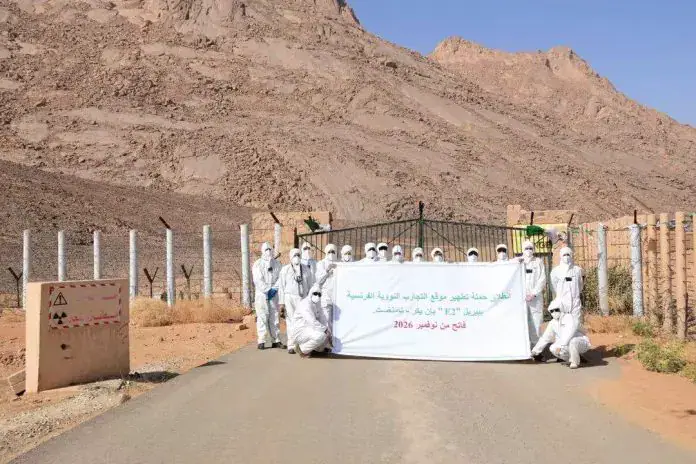
Algeria has initiated the second phase of decontamination operations at the Béryl 2E experimental tunnel site in the In Ecker region of Tamanrasset. The operation, carried out with exclusively national expertise and resources, aims to continue the cleanup of former French nuclear test sites in the country's south. According to the Ministry of National Defense, the operation is supervised by the ministry and coordinated with the National Agency for the Rehabilitation of Former Nuclear Test and Explosion Sites.
The decontamination effort is part of Algeria's ongoing endeavor to address the legacy of French nuclear testing in the region. The French conducted numerous nuclear tests in Algeria during the colonial era, resulting in significant environmental contamination and health concerns for local populations. The Algerian government has taken steps to mitigate the effects of these tests, including the establishment of the National Agency for the Rehabilitation of Former Nuclear Test and Explosion Sites.
The Ministry of National Defense stated that the French authorities have refused to assume their criminal liability and provide records and maps indicating the sites where nuclear waste was buried. These sites continue to hinder the development of the In Ecker and Reggane regions. The Algerian authorities have expressed their determination to proceed with the complete decontamination of nuclear residues left behind by French colonial rule.
The decontamination operation involves the identification of contaminated areas, collection of nuclear waste, and implementation of measures to prevent further environmental damage. The Algerian government has mobilized the necessary human and material resources to carry out this complex operation. The Ministry of National Defense emphasized that the operation will be conducted in strict compliance with international safety standards and protocols.
The Algerian authorities face significant challenges in addressing the legacy of French nuclear testing in the region. The lack of cooperation from French authorities and the absence of accurate records and maps of nuclear waste burial sites complicate the decontamination effort. Despite these challenges, the Algerian government remains committed to completing the decontamination operation and rehabilitating the affected areas.
The decontamination operation is a significant undertaking that requires specialized expertise and equipment. The Algerian government has opted to rely on national expertise and resources, demonstrating its determination to assert its sovereignty and address the environmental and health concerns of its citizens. The operation is expected to have a positive impact on the environment and the local population.
The Algerian government's efforts to decontaminate former nuclear test sites are part of a broader strategy to promote sustainable development and protect the environment. The operation serves as a testament to Algeria's commitment to addressing the legacy of colonialism and promoting the well-being of its citizens.
Key points
- Algeria has launched the second phase of decontamination operations at the Béryl 2E site in Tamanrasset region.
- French authorities have refused to assume their criminal liability and provide records and maps of nuclear waste burial sites.
- The Algerian government has mobilized national expertise and resources to complete the decontamination operation and rehabilitate the affected areas.