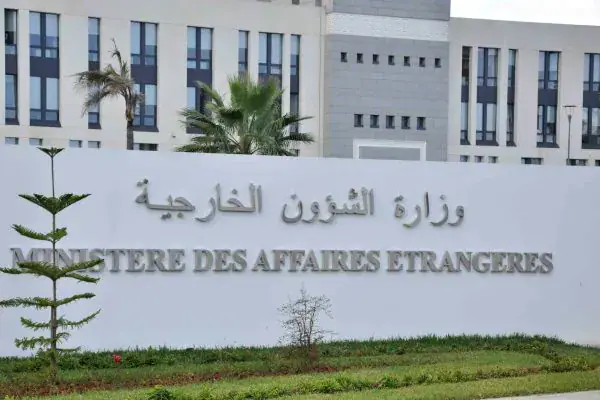
The Algerian government has expressed deep regret over the non-renewal of the mandate of the United Nations Mission for the Referendum in Western Sahara (MINURSO), which expired on October 31. According to a statement by the Ministry of Foreign Affairs, the decision was a result of the biased draft resolution submitted by the United States, which favored Moroccan interests over those of the Sahrawi people. The Algerian government believes that this move will undermine the decolonization process and the fundamental right of the Sahrawi people to self-determination.
The draft resolution, which was voted on by the UN Security Council, has been deemed "unacceptable" by Algeria. The government claims that the text heavily favors Morocco, rendering a just and lasting solution impossible. Before the vote, Algerian Foreign Minister Ahmed Attaf had addressed official démarches to the members of the Security Council, warning them of the critical consequences of such a development. Algeria had emphasized the danger of a resolution that would legitimize the occupation of Western Sahara and undermine the fundamental rights of the Sahrawi people.
Despite some amendments being incorporated into the final text, Algeria believes that the resolution has fundamentally altered the nature of the conflict. The resolution imposes the Moroccan autonomy plan as the sole basis for discussion, effectively restricting the scope of negotiations and predetermining their outcome. This, according to Algeria, confiscates the freedom of choice of the Sahrawi people. Furthermore, the resolution's removal of the letter "R" from the MINURSO acronym is seen as a significant symbolic change that rules out the referendum option.
The Algerian government also criticizes the resolution for excluding the Frente Polisario, the legitimate representative of the Sahrawi people, from presenting its own proposals. Moreover, Algeria accuses the international community of attempting to transform a decolonization issue into a mere humanitarian problem. The Ministry of Foreign Affairs emphasizes that a lasting solution cannot be dissociated from the inalienable right to self-determination.
The current diplomatic tension is part of a decades-long conflict that began with Spain's withdrawal from Western Sahara in 1975. The territory is claimed by Morocco, which controls most of it, while the Frente Polisario, supported by Algeria, demands total independence for the Sahrawi Arab Democratic Republic. In 1991, a ceasefire agreement was reached under UN auspices, accompanied by the creation of MINURSO, which was tasked with organizing a referendum to allow the local population to choose between independence and integration with Morocco.
However, the process has been stalled due to persistent disagreements over the composition of the electoral body, preventing the referendum from taking place. Over the years, the status of Western Sahara has remained a major point of friction in North African geopolitics, pitting Morocco's vision of autonomy under its sovereignty against the principle of self-determination defended by the Frente Polisario and Algeria, in accordance with international law on decolonization.
Algeria reaffirms its commitment to a just and political settlement, in line with the UN Charter and resolutions. The government emphasizes that any solution must be based on the Sahrawi people's right to self-determination and that the international community has a responsibility to ensure that this right is respected. The conflict's outcome will have significant implications for regional stability and the future of the Sahrawi people.
Key points
- Algeria condemns the UN resolution on Western Sahara, citing bias towards Morocco.
- The resolution undermines the Sahrawi people's right to self-determination.
- Algeria reaffirms its commitment to a just and political settlement in line with UN principles.