Tensions between Algeria and France have resurfaced over the issue of nuclear waste from French nuclear tests conducted in the Algerian Sahara during the colonial era. The Algerian Ministry of Defense has accused France of refusing to provide maps and records of radioactive waste burial sites in the regions of In Ekker and Reggane. This has hindered efforts to uncover the truth about these sites and identify areas contaminated by radioactive materials.
The dispute dates back to 1960 when France conducted its first nuclear test in Algeria, followed by 16 more tests until 1966. France had chosen the Algerian Sahara as a site for its nuclear tests, seeking to develop its nuclear capabilities during the Cold War. The tests have left a legacy of radioactive waste, which Algeria claims France has not taken full responsibility for. Algerian authorities demand that France disclose the locations of all nuclear waste sites and take responsibility for the environmental and health impacts.
The French nuclear tests in Algeria have been a point of contention between the two countries since Algeria gained independence in 1962. Despite agreements, including the 1962 Evian Accords, which allowed France to use certain military sites in the Algerian Sahara for a transitional period, the issue of nuclear waste has remained unresolved. France conducted a total of 17 nuclear tests in Algeria, including four atmospheric tests in Reggane and 13 underground tests in In Ekker.
One of the most significant tests was the "Béryl" experiment, conducted on May 1, 1962, in In Ekker. The test resulted in the release of radioactive materials into the environment, raising concerns about exposure to radiation among military personnel, workers, and local populations. Historical accounts and reports indicate that French forces left behind not only test sites but also equipment and contaminated materials, including vehicles, clothing, and tools.
The issue of nuclear waste has resurfaced in recent years, with Algeria demanding greater transparency and accountability from France. In 2008, the two countries established a joint working group to study the rehabilitation of former nuclear test sites in the Sahara, prioritizing the protection of local populations and the environment. French President Emmanuel Macron's visit to Algeria in August 2022 led to the handover of a file containing maps and information on buried waste and affected areas.
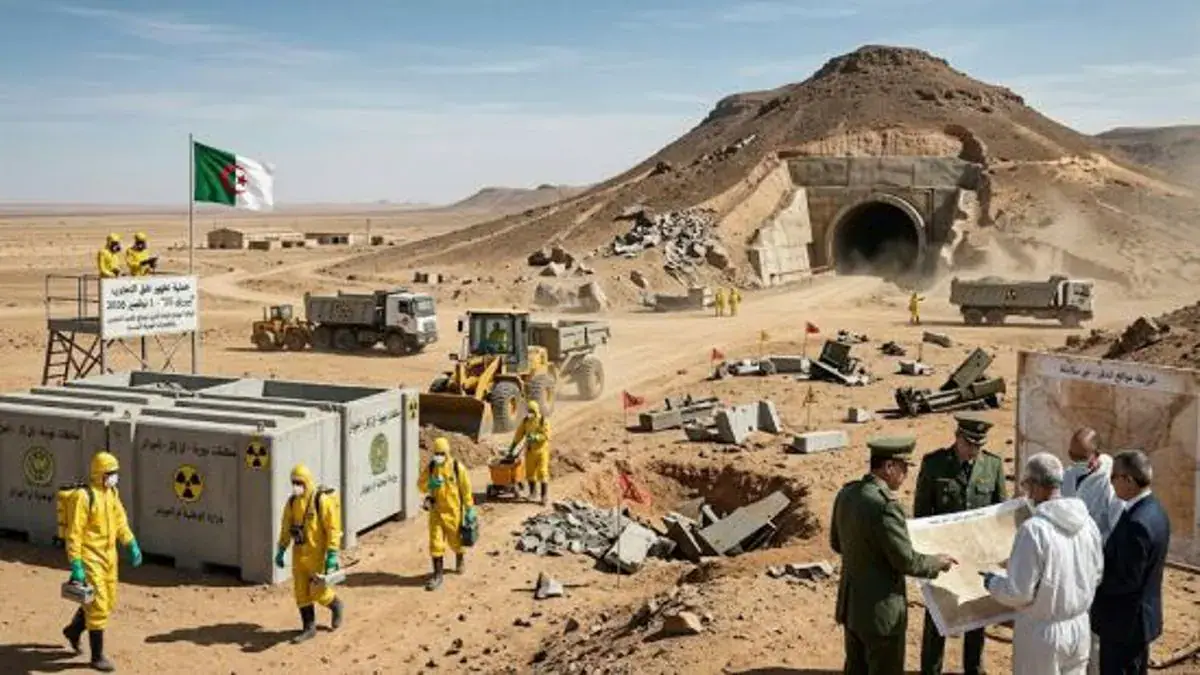
However, the Algerian Ministry of Defense claims that France has refused to provide essential records and maps to identify radioactive waste burial sites. This has complicated efforts to clean up contaminated areas and ensure the safety of local populations and workers. In response, Algeria has launched a new process to decontaminate nuclear test sites, including the "Béryl 2E" site in In Ekker, which involves identifying contaminated areas, collecting radioactive waste, and storing it in specialized containers.
The dispute between Algeria and France highlights the ongoing legacy of colonialism and the need for greater transparency and accountability. The issue goes beyond a simple diplomatic spat, with significant implications for environmental and human health. Algeria's efforts to decontaminate nuclear test sites demonstrate its commitment to addressing the consequences of French nuclear tests, while also underscoring the need for France to take responsibility for its actions.
Key points
- Algeria accuses France of refusing to hand over maps and records of nuclear waste burial sites.
- France conducted 17 nuclear tests in Algeria between 1960 and 1966.
- The dispute highlights the ongoing legacy of colonialism and the need for greater transparency and accountability.