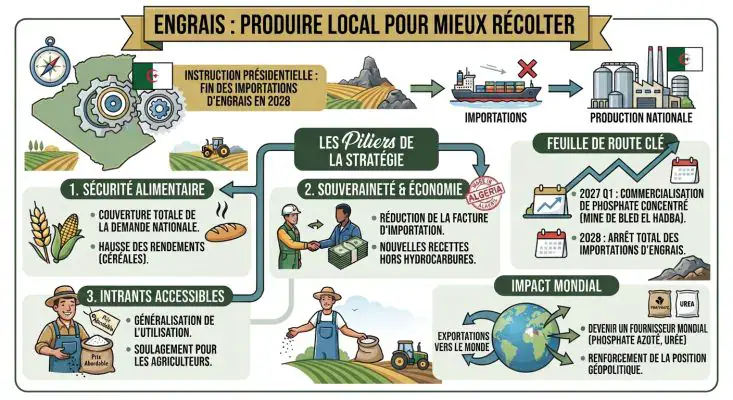
Algeria's President Abdelmadjid Tebboune has made a strategic decision to halt fertilizer imports by 2028, aiming to increase local production and improve agricultural productivity. This move is expected to provide farmers with more accessible inputs, leading to higher yields and potentially securing a position in the global market. The country's quest for food security has just gained a new momentum.
Expert Mohamed Mokrane Nouad believes that producing fertilizers locally will have a significant impact on the agricultural sector. He emphasizes that fertilizers are crucial for improving productivity and have become a geopolitical and economic "weapon" in recent crises. Nouad stresses that they are a determining factor in agricultural technical itineraries, directly affecting production levels.
The security of Algeria's food supply does not solely rely on seed quality or cultivated areas, but also on fertilizers. Nouad notes that without fertilizers, cereal production is not possible. He is convinced that sustainable productivity growth is unattainable without them, particularly in the cereal sector.
During a recent meeting, President Tebboune decided to stop importing fertilizers and fertilizer compounds by 2028. Additionally, the production of concentrated phosphate will enter the commercialization phase in the first quarter of 2027, thanks to the exploitation of the Bled El Hadba mine. Nouad welcomes this decision, believing it will allow for further intensification and performance in national agriculture.
Local fertilizer production will be a significant relief for farmers, as they will have access to affordable fertilizers. This will enable them to use these essential inputs more widely in their technical itineraries. Currently, Nouad observes that fertilizer quantities used are sometimes insufficient due to limited means or availability, affecting crop potential.
Algeria's dependence on external markets for fertilizers poses risks, as disruptions in availability and prices can affect farmers and consumers. Nouad recalls that delays have occurred in the plowing and sowing campaign due to insufficient fertilizer quantities, with consequences for the cultural calendar and harvests.
Expert Nouad is confident that Algeria can meet the challenge of producing enough fertilizers locally within the set deadline. He believes the country has significant potential in mineral resources and industrial capacities, making it possible to cover internal demand and potentially become a global supplier of phosphate and urea, opening up new revenue streams outside of hydrocarbons.
Key points
- Algeria aims to stop importing fertilizers by 2028 and boost local production.
- The move is expected to improve agricultural productivity and make Algeria a potential global supplier.
- Local fertilizer production will enhance food security and provide farmers with more accessible inputs.
Reporting sources
- Engrais : Produire local pour mieux récolter · Le Jeune Indépendant