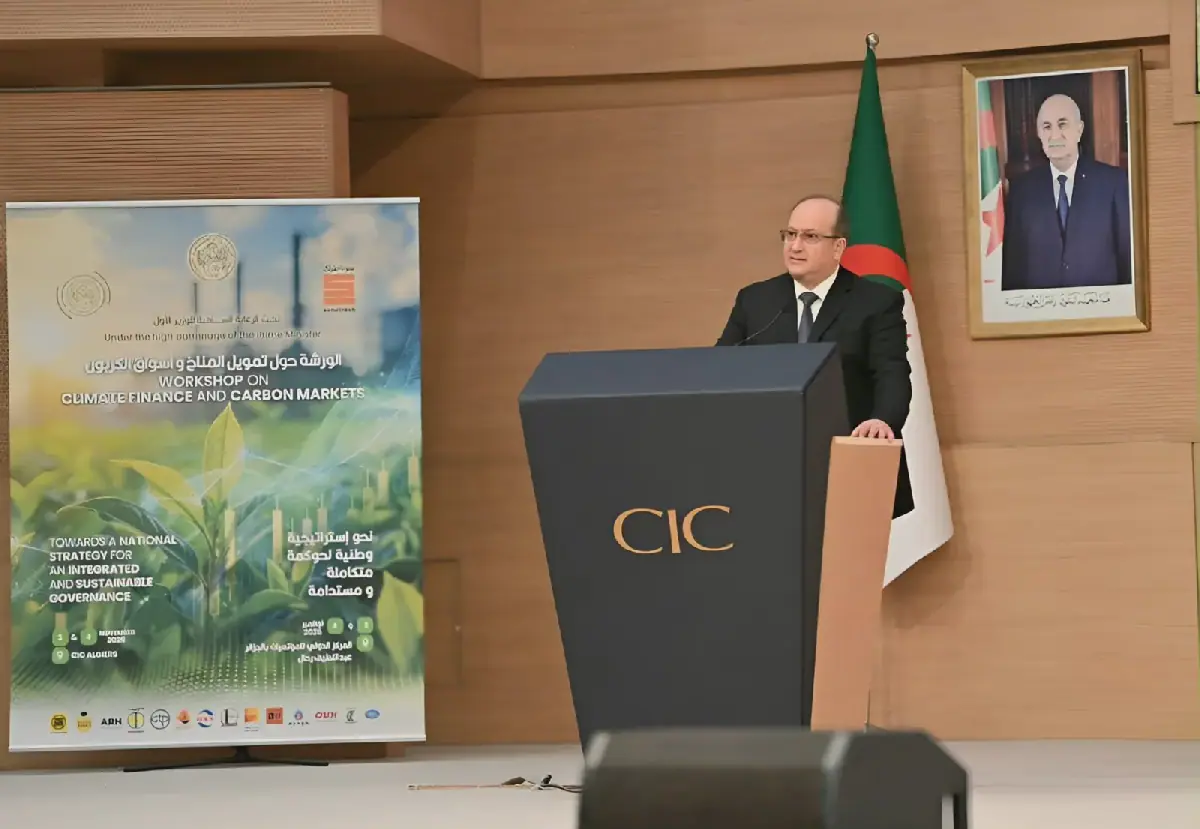
The Algerian government has taken a significant step towards financing its ecological transition by launching a national workshop on climate finance and carbon markets. The two-day event, held at the Centre international des conférences Abdelatif-Rahal in Algiers, brought together members of the government, military officials, national experts, and delegates from international organizations. The workshop aims to translate Algeria's environmental promises into concrete financial mechanisms that can attract capital without jeopardizing its economy, which is heavily dependent on hydrocarbons.
Algeria's new Nationally Determined Contribution (NDC) sets a target of reducing greenhouse gas emissions by 14% by 2035, with a potential increase to 31% if international financing and technology transfers are secured. This conditional approach emphasizes shared responsibility, a stance already defended at the GECF summit in Moscow, where a €22 billion envelope was announced for renewable energies. To achieve these targets, two key levers are being pursued: the national hydrogen strategy, validated in 2023, and a large solar program jointly led by Sonatrach and Sonelgaz.
The energy sector has set an ambitious goal of achieving zero methane emissions by 2030. To achieve this, the government has imposed a roadmap on public groups, prioritizing the complete halt of routine gas flaring and the reduction of methane emissions. This effort builds on previous work with foreign partners, including a letter of intent signed between Sonatrach and Italian group Eni in August to decarbonize oil and gas activities, with a focus on methane leaks.
Algeria is preparing to join the mechanisms provided for by Article 6 of the Paris Agreement, which allows for the exchange of carbon credits between states and operators. The government aims to establish a national carbon market, described as sovereign, with three main objectives: attracting private investment towards low-carbon projects, ensuring the reliability of the measurement, notification, and verification (MRV) system, and protecting the national productive apparatus against environmental barriers in major importing countries.
The creation of a national carbon market is seen as crucial for attracting private capital towards low-carbon projects. This move is also expected to help Algerian exporters navigate the carbon taxes imposed by major importing countries, such as the European Union. Algerian exporters are concerned that these taxes could increase the cost of their energy products, despite growing interest from European buyers in Algerian gas.
Algeria's transition to a low-carbon economy relies heavily on technological partnerships with foreign companies. Discussions with Norwegian group Equinor in June highlighted the need for external expertise, particularly in areas such as carbon capture and storage. The In Salah and In Amenas sites are serving as laboratories for these experiments, with local teams gradually building their skills and competencies.
The success of Algeria's ecological transition depends on its ability to secure international financing and technology transfers. The government is seeking to balance its economic development with environmental protection, a challenge shared by many countries. As the country prepares for the COP31 conference, it is clear that Algeria's commitment to reducing emissions and transitioning to a low-carbon economy will require continued international cooperation and support.
Key points
- Algeria aims to reduce greenhouse gas emissions by 14-31% by 2035, with a focus on securing international financing and technology transfers.
- The country is establishing a national carbon market to attract private investment towards low-carbon projects and protect its productive apparatus against environmental barriers.
- Algeria's transition to a low-carbon economy relies on technological partnerships with foreign companies, particularly in areas such as carbon capture and storage.