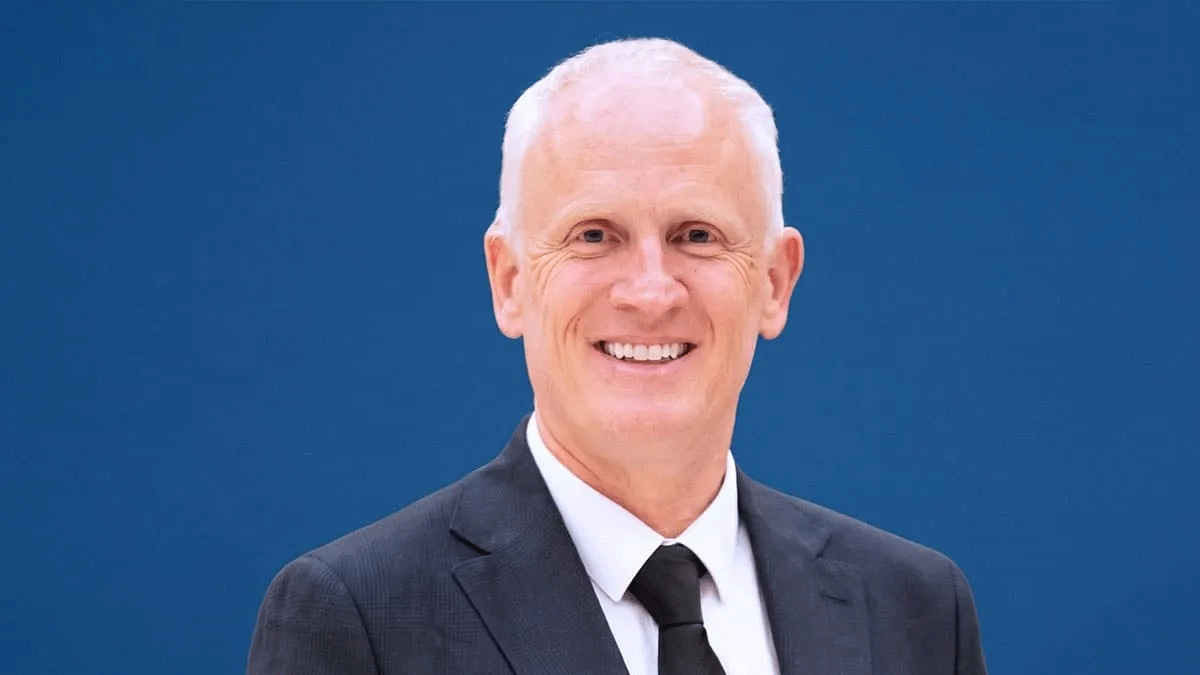
Alexander Kremer has assumed his role as the new representative of the World Bank Group in Tunisia. His appointment comes at a critical time, midway through the 2023-2027 Partnership Framework. This framework focuses on private employment, human capital, and climate resilience. Kremer's challenge will be to oversee the implementation of ongoing projects and the reforms that come with them. The World Bank has a significant portfolio in Tunisia, with several projects already underway.
Water and energy are two major areas of focus for Kremer. The World Bank has invested $332.5 million in two projects aimed at improving water security and resilience. The bank estimates that water scarcity could reduce Tunisia's GDP by 6.4% by 2050 if left unaddressed. In the energy sector, the TEREG program, worth $430 million over five years, aims to increase the use of renewable energy, improve electricity reliability, and enhance sector governance.
The reform of public enterprises and the business environment is another critical area. A World Bank document published in 2025 highlights the need for these reforms to achieve growth and macroeconomic stability. The social sector also remains a priority, with the World Bank approving an additional $90 million in March 2026 to strengthen the social protection system. This comes on top of an initial $700 million project.
Kremer will also oversee the financing of entrepreneurship, particularly for startups and small and medium-sized enterprises (SMEs). A project worth $75 million, launched to support innovative startups and SMEs, has mobilized $47 million in private capital as of 2025. However, the World Bank continues to identify regulatory barriers and weak investment as major constraints on Tunisia's growth.
The issue of investment is a transversal concern for Kremer. His role, which now covers the International Bank for Reconstruction and Development (IBRD), the International Finance Corporation (IFC), and the Multilateral Investment Guarantee Agency (MIGA), gives him a new dimension in articulating financing, public reforms, and private capital.
Kremer's agenda is extensive, with several projects and initiatives already underway. The World Bank's engagement in Tunisia is significant, with a focus on supporting the country's economic development and resilience. The bank's projects aim to address some of Tunisia's most pressing challenges, including water scarcity, energy security, and social protection.
As Kremer begins his tenure, he will need to navigate these complex issues and prioritize the bank's efforts. The Partnership Framework provides a clear roadmap for the bank's engagement in Tunisia, and Kremer will play a critical role in implementing these plans. His experience and expertise will be essential in addressing the country's development challenges.
Key points
- The World Bank has invested $332.5 million in water security and resilience projects in Tunisia.
- The bank's TEREG program aims to increase the use of renewable energy and improve electricity reliability.
- Kremer's role covers IBRD, IFC, and MIGA, giving him a new dimension in articulating financing, public reforms, and private capital.