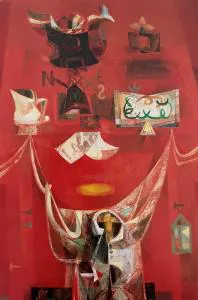
The Agencia Española de Cooperación Internacional para el Desarrollo (AECID) is currently showcasing Alejandro Obregón's influential artwork, Mesa del Gólgota. Born in Barcelona in 1920, Obregón moved to Barranquilla, Colombia, with his family at the age of six. He later resided in France and New York before returning to Colombia in the mid-1950s with a fully defined pictorial language. Mesa del Gólgota, created around 1952, marks a turning point in Obregón's career, incorporating a symbolic language that would persist in his subsequent work.
Mesa del Gólgota is a representation of the Passion of Christ, featuring a crown of thorns, nails holding a cloth, and the INRI sign. This artwork presents a spiritual and fragmented vision of the crucifixion, diverging from traditional depictions. In 1955, Mesa del Gólgota was exhibited at the Pan American Union in Washington, alongside other works from Obregón's French period, such as Tres copas. The reverendo Robert Hunsicker acquired the piece for his private collection in New York, while Alfred H. Barr, director of the MoMA, purchased Souvenir de Venecia (1954) for the museum's collection.
The artwork received a prize of 50,000 pesetas at the III Hispano-American Biennial of Art in Barcelona in 1955. Obregón also received the first Guggenheim Prize with Estudiante muerto (1956) that same year. He participated in the I Biennial of Caribbean and Gulf of Mexico Art in Houston. Considered one of the most influential artists of the 20th century in Colombia and Latin America, Obregón renewed the plastic tradition and introduced modernity to the country's art scene.
Obregón's painting style, characterized by vigorous brushstrokes and expressive marks, inspired notable figures such as Fernando Botero and Cecilia Porras. The Argentine critic Marta Traba defined him as "the first Colombian modern artist" due to the originality of his pictorial language. Mesa del Gólgota was loaned to the National Library of Spain in 2011 for the exhibition América Latina. 200 años de historias (1810–2010), organized by Acción Cultural Española to commemorate the bicentennial of American independence.
There exists another version of Mesa del Gólgota, created in 1956, with a smaller size and similar theme. This version, titled La mesa del Gólgota, measures 160 x 140 cm and is an oil on canvas piece. More information about Obregón's work can be found in the catalog Catálogo de la colección artística de la Agencia, authored by Mª Blanco Conde in 2016.
Alejandro Obregón Rosés passed away in Cartagena de Indias in 1992, leaving behind a legacy as a pioneering modern artist in Colombia. His work continues to be celebrated for its innovative style and influence on subsequent generations of artists. The AECID's collection includes Obregón's Mesa del Gólgota, which serves as a testament to his significant contribution to the country's art scene.
The artwork is part of the AECID's collection, which features a diverse range of pieces that reflect the agency's commitment to promoting cultural exchange and cooperation. Visitors can view Mesa del Gólgota and other notable works at the AECID's headquarters in Madrid. The agency's collection is a valuable resource for those interested in exploring the rich cultural heritage of Latin America and Spain.
Key points
- Alejandro Obregón's Mesa del Gólgota is a seminal work that showcases the artist's unique style and symbolic language.
- The artwork has been exhibited in various international venues, including the Pan American Union in Washington and the National Library of Spain.
- Obregón's legacy as a pioneering modern artist in Colombia continues to inspire new generations of artists and art enthusiasts.