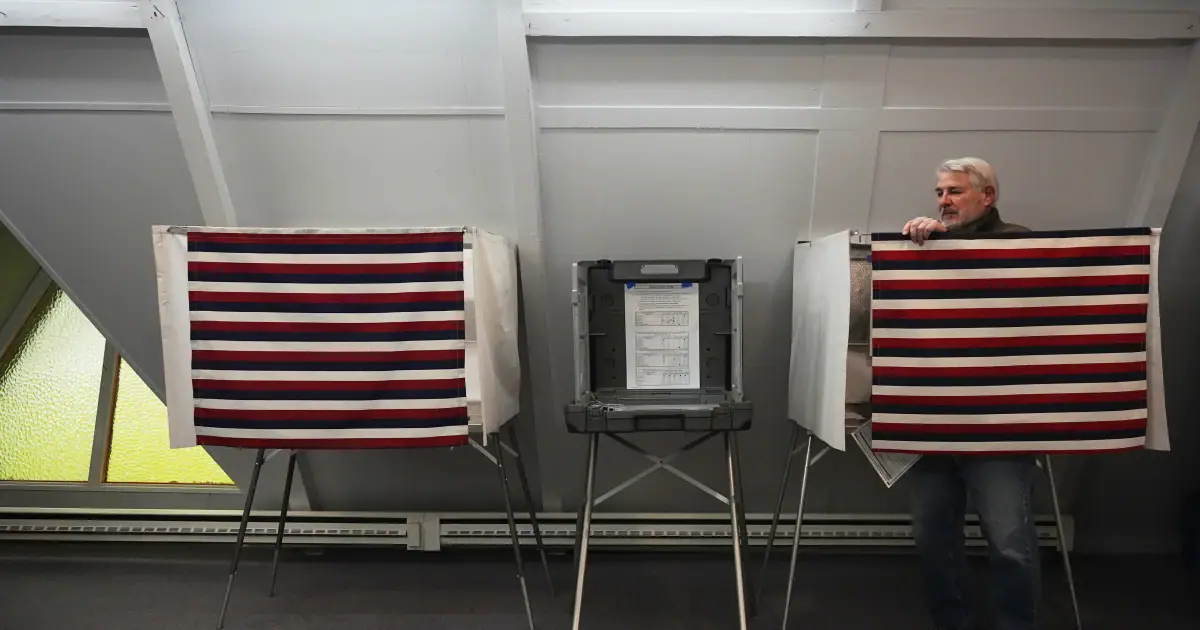
Alaska voters have decisively rejected a ballot measure that would have repealed the state's nonpartisan primary system and ranked choice voting. According to an overnight race call by the Associated Press, the measure failed, marking the second time Alaskans have voted down an effort to repeal the system, which was first approved in 2020. A previous repeal effort in 2024 also failed narrowly.
The Alaska election system allows voters of all political affiliations to vote on the same primary ballot, with the top four candidates advancing to the general election. If no candidate receives a majority of the general election vote, ranked choice voting is used to determine the winner. This system has been under intense nationwide scrutiny, particularly due to a closely watched Senate race featuring two candidates with the same name, Dan Sullivan.
Proponents of Alaska's system argue that it allows voters the freedom to vote for any candidate, regardless of party, in every taxpayer-funded election. Nick Troiano, executive director of Unite America, a philanthropic venture fund that invests in nonpartisan electoral reform, stated that Alaskans have shown that a better way is possible, and it is time to honor the voters' decision and move forward.
Opponents of Alaska's elections claim that the current system is confusing and can be manipulated. They pointed to the Senate race, where an independent candidate named Dan Sullivan was alleged to be a Democratic-backed spoiler recruited to siphon votes from the Republican incumbent, also named Dan Sullivan. However, Democrats denied recruiting the independent Sullivan, who defended his candidacy and made the top-four general election ballot.
Despite opposition, proponents argue that Alaska's ranked choice voting system can mitigate confusion. Voters had the ability to rank both Dan Sullivans and not rank Democrat Mary Peltola, for example. This system is unique, with only a few states having nonpartisan primary systems similar to Alaska's. California and Washington's systems allow the top two vote getters to advance to the general election, but Alaska's system allows the top four candidates to move on.
The outcome of this vote reflects a broader trend, with Massachusetts voters this year deciding not to switch to a top-two nonpartisan primary system. In the 2024 election cycle, several states considered measures to create a nonpartisan system similar to Alaska's, but voters rejected all of those ballot measures. This suggests that voters are choosing to maintain or adopt unique election systems.
The decision to keep Alaska's ranked choice voting system in place may have implications for future elections. As the system continues to be used, it will be closely watched by other states considering electoral reform. The outcome will likely be seen as a validation of Alaska's approach to nonpartisan primary systems and ranked choice voting.
Key points
- Alaska voters have rejected a ballot measure to repeal the state's nonpartisan primary system and ranked choice voting.
- The system allows voters of all political affiliations to vote on the same primary ballot, with the top four candidates advancing to the general election.
- The outcome reflects a broader trend, with other states also considering or rejecting similar electoral reforms.