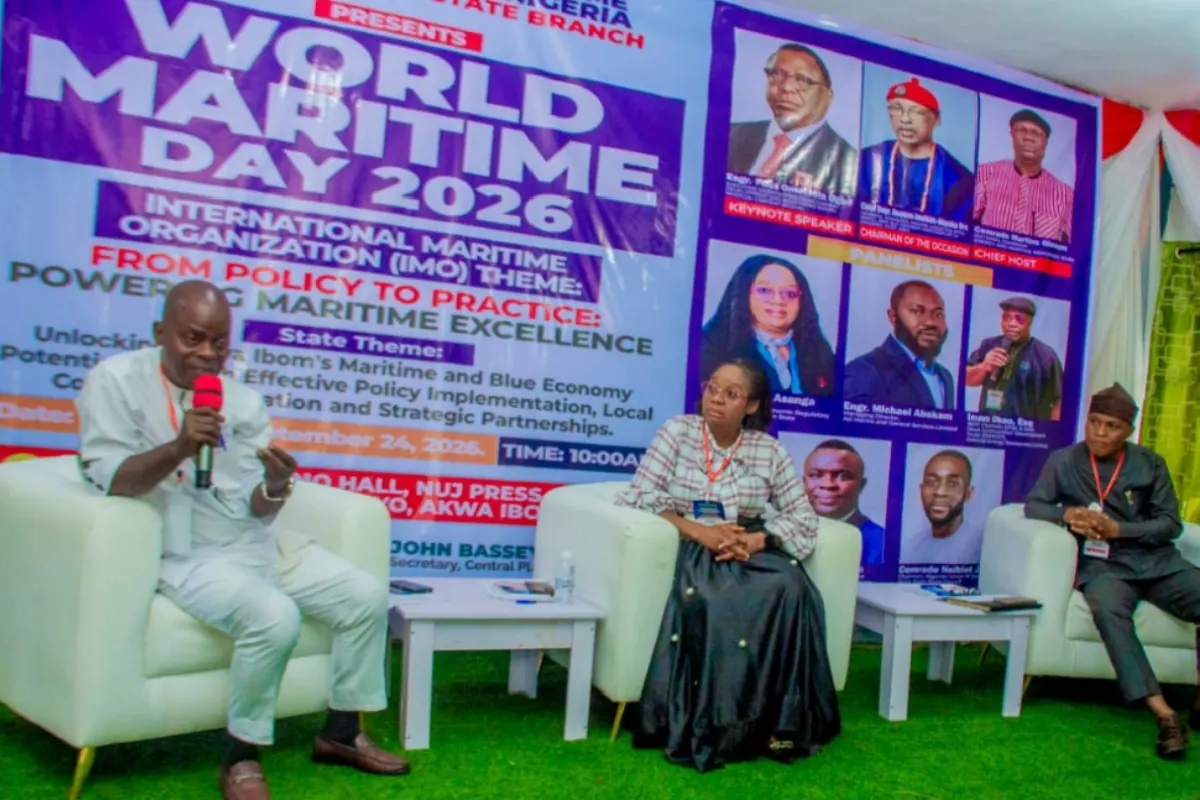
Maritime stakeholders in Akwa Ibom State have urged the state government to establish a Ministry of Blue Economy to develop the state's maritime resources, coordinate investments, and accelerate critical blue-economy projects. This call was made during the 2026 World Maritime Day celebration in Uyo, organized by the Akwa Ibom State Branch of the Energy and Maritime Reporters of Nigeria. The stakeholders emphasized that the state has enormous maritime resources, including extensive waterways, coastal assets, fisheries, logistics corridors, and strategic offshore and onshore opportunities.
The stakeholders observed that Akwa Ibom's maritime potential can only translate into economic benefits if the government and stakeholders move beyond policy declarations to implement measurable projects that create jobs, businesses, revenue, and improved livelihoods. They identified the Ibom Deep Seaport, Ibom Fish City, Oron Maritime Infrastructure Project, and Ibom Solutions Hub Industrial Park as strategic projects requiring accelerated implementation. The stakeholders also called for clear funding arrangements, timelines, accountability mechanisms, and measurable milestones for these projects.
The stakeholders also demanded the full operationalization of the University of Maritime Studies, Oron, which is critical to producing skilled manpower to support emerging maritime infrastructure and investments in the state. They further called for stronger participation of host communities and Akwa Ibom indigenes in maritime value chains through skills acquisition, technical and vocational training, employment, enterprise development, and local contracting opportunities.
The stakeholders urged stakeholders to position indigenes as engineers, seafarers, technicians, fabricators, environmental experts, logistics providers, marine service operators, suppliers, and entrepreneurs across maritime and industrial value chains. They advocated for the strategic harnessing of Oron's maritime potentials in alignment with the ARISE Agenda of the state government and called for stronger partnerships among the Federal and State Governments, maritime agencies, the Nigerian Navy, investors, financial institutions, development partners, private-sector operators, and host communities.
The gathering also charged the media to sustain professional, factual, developmental, and solution-oriented reporting of the maritime sector, particularly in monitoring government policies, investments, and project implementation to promote transparency, accountability, and public awareness. The stakeholders recommended introducing performance indicators for the maritime sector, including jobs created, businesses established, growth in fisheries production, cargo and passenger traffic, investments attracted, skills acquired, revenue generated, and improvements in community welfare.
Chairman of the occasion, Hon. Moses Essien, said the communiqué had provided a practical roadmap for converting Akwa Ibom's maritime advantages into tangible economic opportunities. He emphasized that the focus should now be on implementation and that the state could derive greater economic value from its coastal resources if government, investors, communities, and other stakeholders worked together to develop the necessary infrastructure, human capacity, and maritime value chains.
The stakeholders reaffirmed that a vibrant maritime sector was indispensable to the sustainable economic transformation of Akwa Ibom and called for collective action to position the state as a leading blue-economy destination in Nigeria and West Africa. The proposed Ministry of Blue Economy would provide a dedicated platform for coordinating the sector, promoting investment, and ensuring that maritime projects delivered measurable benefits to the people of the state.
Key points
- Maritime stakeholders in Akwa Ibom State are demanding a dedicated Ministry of Blue Economy to drive development and coordinate investments in the state's maritime resources.
- The stakeholders identified strategic projects, including the Ibom Deep Seaport, Ibom Fish City, and Oron Maritime Infrastructure Project, which require accelerated implementation.
- The stakeholders also called for stronger participation of host communities and Akwa Ibom indigenes in maritime value chains through skills acquisition, technical and vocational training, employment, enterprise development, and local contracting opportunities.