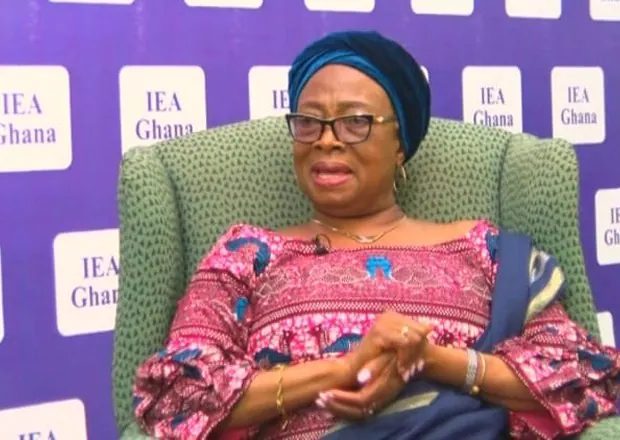
Former Chief Justice Sophia Akuffo has stated that Ghana's Constitution has failed to give citizens outside major cities a meaningful voice in local decision-making. Speaking at an Institute of Economic Affairs (IEA) forum on October 6, 2026, Akuffo argued that the country's democratic system needs restructuring to enable citizens to shape decisions affecting their daily lives. She noted that the current system leaves ordinary citizens, particularly those in rural areas, with weakened influence over development priorities in their communities.
Akuffo, now a Senior Fellow at the IEA, claimed that the 1992 Constitution's implementation has concentrated decision-making power in a relatively small group, marginalizing ordinary citizens. She used an analogy to describe the imbalance, suggesting that those not involved in decision-making risk becoming part of what is shared out by those who are. This disparity is evident in the distribution of resources and opportunities between urban centers and rural areas, where residents often have little say in choices that directly affect them.
The former Chief Justice emphasized that citizen participation must be at the heart of any constitutional reform. She called for specific provisions to guarantee ordinary people a direct role in decisions taken at the local level. Akuffo noted that the Constitution, even in its current form, is meant to give the voice of the people considerable weight, but true democracy can only take hold when citizens participate meaningfully in major choices.
The IEA forum where Akuffo spoke was centered on the Prempeh Committee's report and the government's position on constitutional review. Her comments add a significant legal voice to the ongoing debate on reassessing Ghana's Constitution. The forum's discussions highlight that the constitutional review touches not only on the structure of the presidency but also on power distribution between Accra and the districts, and between officials and ordinary citizens.
Akuffo's argument resonates with Ghanaians living outside Accra, Kumasi, and other major cities, who have long-standing frustrations over who controls decisions on local development priorities. If constitutional reforms follow her recommendation, citizens could gain a more direct say in how local development is planned and funded. This could lead to more inclusive decision-making processes and better representation of rural communities' interests.
The debate on constitutional reform has drawn in other prominent figures, including Togbe Afede, who warned against a proposal to extend the presidential term to five years. The interventions illustrate the complexities of the constitutional review process and the need for careful consideration of its implications. The Prempeh Committee's report remains under discussion as part of the broader constitutional review process.
The timeline for adopting, amending, or rejecting the Prempeh Committee's recommendations is unclear, as is the potential introduction of concrete provisions on local participation. Further parliamentary or public engagement on these proposals has not been scheduled. The constitutional review process is ongoing, with various stakeholders contributing to the discussion on Ghana's future governance structure.
Key points
- Former Chief Justice Sophia Akuffo calls for constitutional reforms to give citizens a direct role in local decision-making.
- Akuffo argues that the current system concentrates power in a small group, marginalizing ordinary citizens.
- The constitutional review process has sparked debate on power distribution between Accra and the districts, and between officials and ordinary citizens.