The Akatamanso War, which took place on August 7, 1826, near Dodowa, is a significant event in Ghana's military history that continues to resonate with the people of Akuapem. According to Historian and Genealogist at the Institute of African Studies, University of Ghana, Mr. Kwaku Darko Ankrah, the war was a defining moment that reaffirmed Akuapem's independence and strengthened the sense of common purpose among its constituent communities. The victory also led to the transformation of a military achievement into one of Ghana's most enduring traditional festivals – Odwira, which in Akan means "purification".
Akuapem had already established its political and spiritual autonomy following the formation of the Akuapem State in the 18th Century. The 1826 conflict, therefore, did not create Akuapem's independence but rather became a moment when the people defended that independence against the possibility of being absorbed into a wider Asante political order. Mr. Ankrah explained that Akuapem's participation in the war had a historical dimension of its own, dating back to the defeat of Akwamu and the subsequent Abotakyi political settlement in 1733.
The origins of the Akatamanso war lay partly in the military confrontation of 1824, when Asante forces defeated a British-led force at Nsamankow and killed Governor Sir Charles MacCarthy. This defeat altered the political calculations of the coastal states, and when Asantehene Osei Yaw Akoto subsequently moved south in 1826, the prospect of an Asante victory carried implications beyond the immediate battlefield. Akuapem was part of a broader coalition in which different communities, despite their own political and historical differences, found a common interest in resisting Asante expansion.
Akuapem did not go to the Akatamanso war as a single homogeneous ethnic group; its various military groups contributed warriors to the wider allied force. Historical accounts, including the work of Wyndham, contain names of Akuapem warriors who participated in the campaign, such as warriors and chiefs associated with Larteh, Amanokrom, and other Akuapem communities. Nana Addo Dankwa I, the then Okuapehene, is also identified as having participated in the fighting, while Akonfla of Larteh acquired the appellation "Ojiafana" following his conduct during the battle.
One of the most powerful traditions surrounding the battle concerns sacred objects said to have been taken from the defeated Asante forces. The object known in Akuapem tradition as Odwira Apafram and the Odosu, initially associated with the religious celebration of Odwira among the Asante, were reportedly captured during the Asante retreat and subsequently brought into Akuapem. The capture transformed a military trophy into a ritual symbol, which was incorporated into a new ritual framework through which the community could continually recall the achievement of its ancestors.
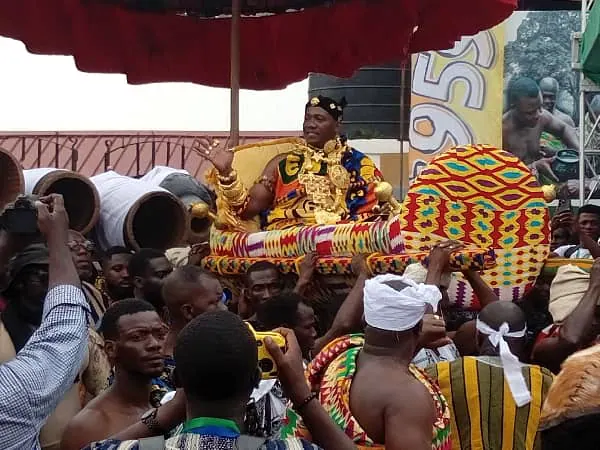
Akuapem tradition associates the establishment of the Odwira festival with the reign of the 19th Okuapehene, Nana Addo Dankwa I, who ruled from 1811 to 1835. The first Akuapem Odwira celebration took place in October 1826, shortly after the Akatamanso victory. The festival commemorated victory, expressed gratitude to the ancestors, marked spiritual purification, celebrated the harvest, and gave the diverse communities that constituted Akuapem a common ritual space.
Today, Odwira is sometimes viewed primarily through its colourful processions, drumming, dancing, traditional regalia, and communal celebrations. However, beneath the pageantry is a historical narrative of survival. The festival's rituals of preparation, purification, remembrance of ancestors, new yam, and the cleansing of sacred stools are part of a much older Akan ritual world. Yet in Akuapem, these practices acquired a distinctive historical meaning after the Akatamanso conflict, serving as a cultural vessel into which the community poured memories of political struggle, ancestral sacrifice, and collective survival.
Key points
- The Akatamanso War of 1826 was a defining moment in Ghana's military history that reaffirmed Akuapem's independence.
- The victory led to the creation of the Odwira festival, which commemorates victory, expresses gratitude to the ancestors, and marks spiritual purification.
- The festival has become a cultural vessel into which the community poured memories of political struggle, ancestral sacrifice, and collective survival.