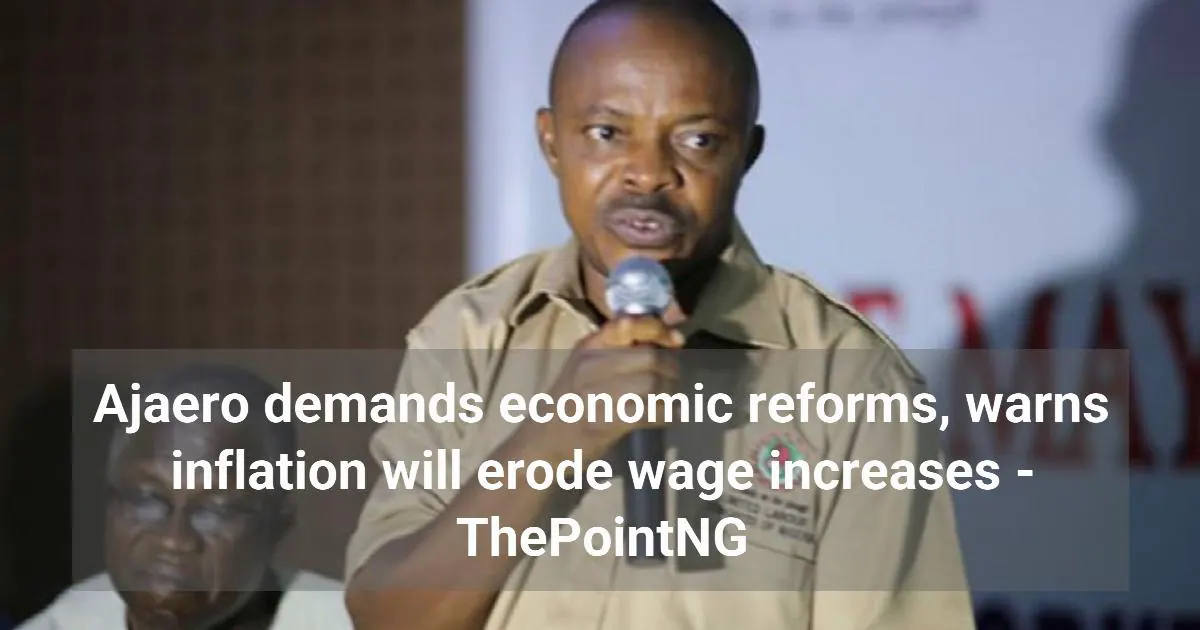
Nigeria Labour Congress President Joe Ajaero has urged the government to implement comprehensive economic reforms, warning that wage increases will have limited impact on workers unless underlying factors driving inflation and the rising cost of living are addressed. Speaking during a webinar organised by the Workers’ Rights Campaign and the Elegant Nurses Forum, Ajaero expressed concern over the lack of a clearly defined national development strategy. He argued that 66 years after independence, Nigeria still lacks coherent policies to guide critical sectors of its economy.
Ajaero lamented the absence of a comprehensive development framework comparable to the 10-year plan introduced at independence, which outlined specific targets for the construction of power stations, roads, railway lines and universities. He argued that successive administrations had failed to establish a similarly coordinated approach to national development, leaving major economic decisions without a sufficiently clear policy framework. Ajaero criticised the government’s unwillingness to encourage broad national discussions on major economic policies.
The labour leader recalled that the military government of General Ibrahim Babangida provided opportunities for Nigerians to debate the country’s system of government and submit recommendations. He maintained that the current civilian administration had not demonstrated a comparable willingness to initiate a national conversation on pressing economic challenges. Ajaero stated that the labour movement wants the government to articulate a clear economic direction that will provide a basis for meaningful wage negotiations.
Ajaero stressed that wage negotiations should not be conducted in isolation from broader economic policies, particularly those influencing inflation, production costs, employment and workers’ purchasing power. He explained that the development of the working class had been shaped by decades of struggles over wages, economic conditions and political participation. Ajaero traced the history of workers’ resistance to the pre-colonial period, highlighting the 1945 general strike and the 1949 Iva Valley shooting as significant events.
The NLC president noted that the major concerns of Nigerian workers over the decades had remained largely unchanged, with successive struggles centred on wages, petroleum product pricing, inflation and access to political participation. He criticised Nigeria’s continued dependence on the export of raw materials and the importation of finished products, describing the economic structure as a major obstacle to industrial development and employment generation.
Ajaero alleged that workers who opposed the Nigerian Civil War on class-conscious and anti-working-class grounds were subjected to various forms of victimisation, further undermining solidarity within the labour movement. He warned that without corresponding economic reforms, even substantial increases in the national minimum wage would eventually be eroded by rising prices, leaving workers with little improvement in their purchasing power.
Also speaking at the webinar, Gbenga Komolafe expressed concern over the dominance of informal employment in Nigeria, describing the size of the sector as an indication of the country’s declining productive capacity and persistent economic underdevelopment. The event was moderated by Baba Aye and featured discussions on Nigeria’s economic trajectory since independence and the working class 66 years after independence.
Key points
- Joe Ajaero calls for comprehensive economic reforms to address inflation and rising cost of living.
- Ajaero criticises government’s unwillingness to encourage national discussions on major economic policies.
- The labour movement wants a clear economic direction for meaningful wage negotiations.