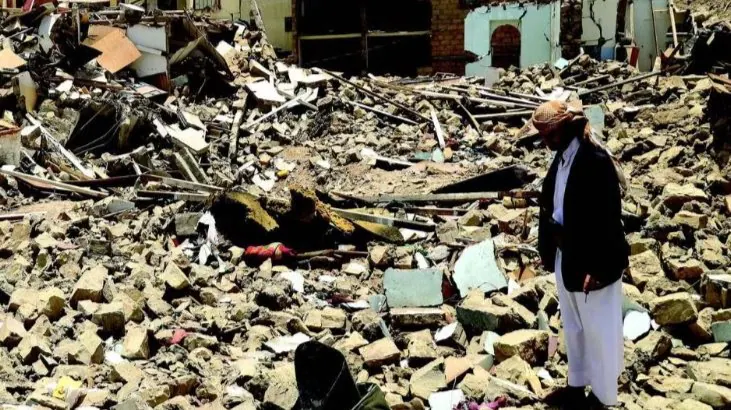
In a significant escalation of the conflict in Yemen, warplanes launched approximately 77 airstrikes on Houthi targets in the capital city of Sana'a and other provinces overnight. The airstrikes, which were carried out using F-15 and Typhoon aircraft, targeted various Houthi strongholds, including military camps and infrastructure. The Houthi military spokesperson, Brigadier General Yahya Saree, confirmed that the airstrikes were accompanied by rocket fire from Najran, Saudi Arabia.
The airstrikes were concentrated in several areas, including the Al-Hafa military camp and Jebel Naqm, east of Sana'a. Residents reported that three waves of airstrikes hit multiple targets, causing massive explosions and fires. The airstrikes also targeted areas near Sana'a International Airport and the Al-Dailami Air Base. According to Houthi sources, at least two people were killed and two others injured in an airstrike on Sana'a Airport.
The escalation in airstrikes coincides with intense battles between government forces and Houthi rebels on multiple fronts. In the Taiz province, fierce fighting erupted in rural areas, with government forces launching a large-scale operation in the Bab al-Mandab region. The strategic location, overlooking the international waterway, has been a key battleground in the conflict. Government forces reportedly made significant gains, capturing several Houthi positions.
However, Houthi forces claimed to have repelled government advances in the area, launching ballistic missile strikes and artillery attacks on government positions. According to Houthi sources, over 22 military vehicles were destroyed, and dozens of soldiers were killed or injured. The Houthis also claimed to have targeted government forces in the Lahj province, inflicting significant casualties.
In the Marib province, government forces engaged in intense battles with Houthi rebels, resulting in significant casualties on both sides. The Yemeni Ministry of Defense reported that 22 soldiers were killed in action, while dozens of Houthi fighters were also killed or injured. Government forces, backed by popular resistance fighters, launched attacks on Houthi positions, seizing control of several areas.
The conflict in Yemen has resulted in significant humanitarian suffering, with thousands of civilians displaced or killed. The Yemeni government and international community have called for a ceasefire, but efforts to negotiate a peaceful resolution have been met with resistance from both sides. The situation remains volatile, with ongoing clashes and airstrikes reported across the country.
The renewed escalation in violence has raised concerns about the humanitarian situation in Yemen, which is already considered one of the world's worst humanitarian crises. The international community has urged restraint and called for a return to peace talks to end the conflict, which has now entered its seventh year. The Houthi rebels and the Yemeni government have yet to comment on any potential peace negotiations.
Key points
- The conflict in Yemen has resulted in significant humanitarian suffering, with thousands of civilians displaced or killed.
- The Yemeni government and international community have called for a ceasefire, but efforts to negotiate a peaceful resolution have been met with resistance from both sides.
- The situation remains volatile, with ongoing clashes and airstrikes reported across the country.