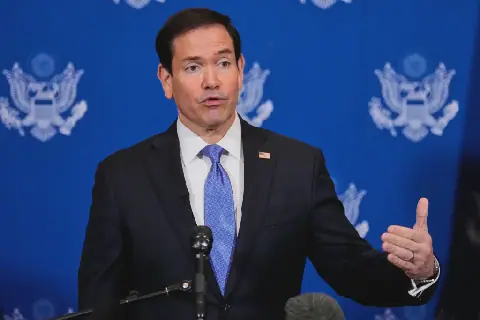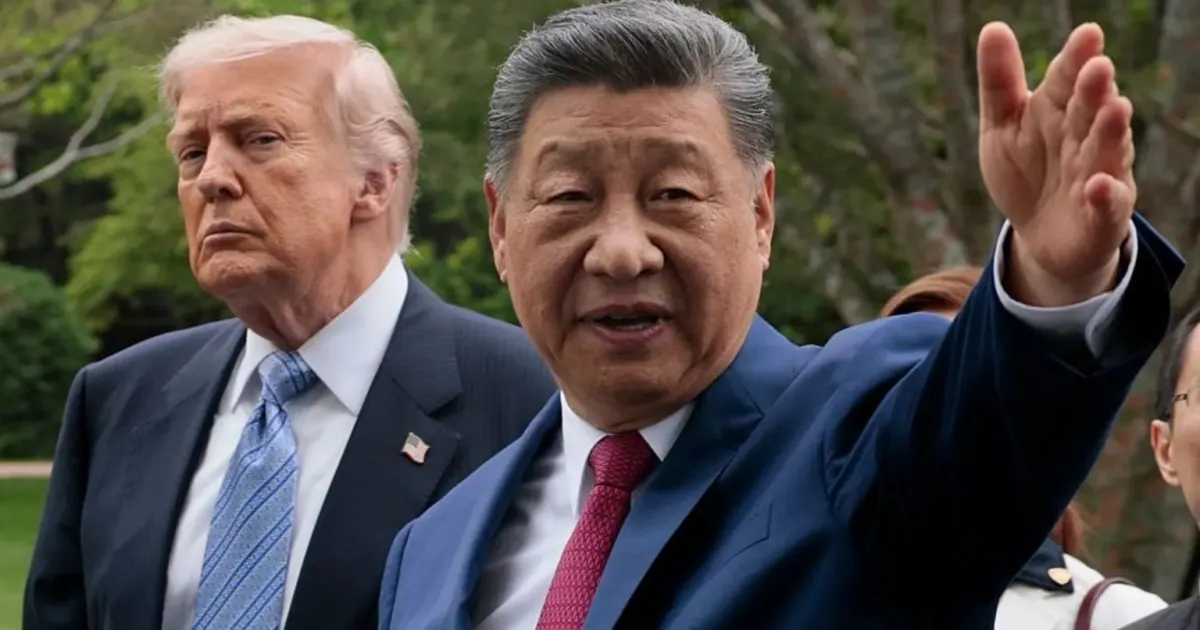
US President Donald Trump has expressed his desire for the US to lead in AI, stating that "whoever wins AI, wins!" His Chinese counterpart, Xi Jinping, has not made similar statements, but China has been investing heavily in AI technology for over a decade. According to Rebecca Arcesati from the Mercator Institute for China Studies, China sees AI as a "power maximiser" and aims to be the leading force in the field. This has set the stage for a meeting between Trump and Xi, where their AI ambitions will likely be a key topic of discussion.
The US and China are currently global leaders in AI, but who is ahead depends on how success is measured. American companies, such as Anthropic, Google, and OpenAI, lead in so-called frontier models, with the highest-performing systems on most benchmarks. However, China's DeepSeek AI model briefly matched the top US model in February 2025, and as of March 2026, Anthropic's top model led by just 2.7%, according to researchers at Stanford University. The US advantage is partly due to the vast sums invested in leading AI companies, which has driven growth and projected profitability.
China's AI industry has taken a different approach, focusing on releasing open weight models that are downloadable and tweakable, similar to open-source software. This contrasts with the approach taken by many US firms, which focus on proprietary models accessed through paid subscriptions or company platforms. Chinese open weight models are being released rapidly, with benchmarks showing the country's top models trailing US rivals by only a few months. Models like Moonshot AI's Kimi K3 have become popular in China and overseas due to their performance and adaptability.
Beijing's focus is on deploying AI technology across its economy, rather than just creating frontier models. According to Lizzi Lee from the Asia Society Policy Institute, "AI isn't the moon landing" and China can still gain economic and geopolitical leverage by making capable AI cheap, open, and ubiquitous. China's advantage in energy costs also plays a significant role, with Chinese AI companies able to access electricity at a much lower cost than their US counterparts.
China has become the world's biggest manufacturer of robots, with over two million working in the country's factories, according to the International Federation of Robotics. The nation is also the world's biggest maker of humanoid robots, accounting for over nine-tenths of global shipments in the first half of the year, according to Chatham House. Chinese AI developers have shown "remarkable resilience and innovation" despite the shortage of advanced American chips.
The US and China have different approaches to safety concerns, with Chinese researchers less concerned about existential risks and more worried about potential misuse and cyber war. Trump has stated that the US already has sufficient rules in place and that the only guardrails AI needs are a "high IQ" president. In contrast, Xi has urged leaders to keep a close eye on AI's risks and ensure the technology is always "under human control".
The meeting between Trump and Xi will have significant implications for the future of AI development and governance. As the two leaders discuss their AI ambitions, they will need to balance their desire for supremacy with concerns about safety and regulation. The outcome of their discussions will matter to the whole world, as AI continues to shape the global economy and society.
Key points
- The US and China are vying for AI supremacy, with both nations investing heavily in the technology.
- China's AI industry has taken a different approach, focusing on open weight models and deployment across its economy.
- The meeting between Trump and Xi will have significant implications for the future of AI development and governance.