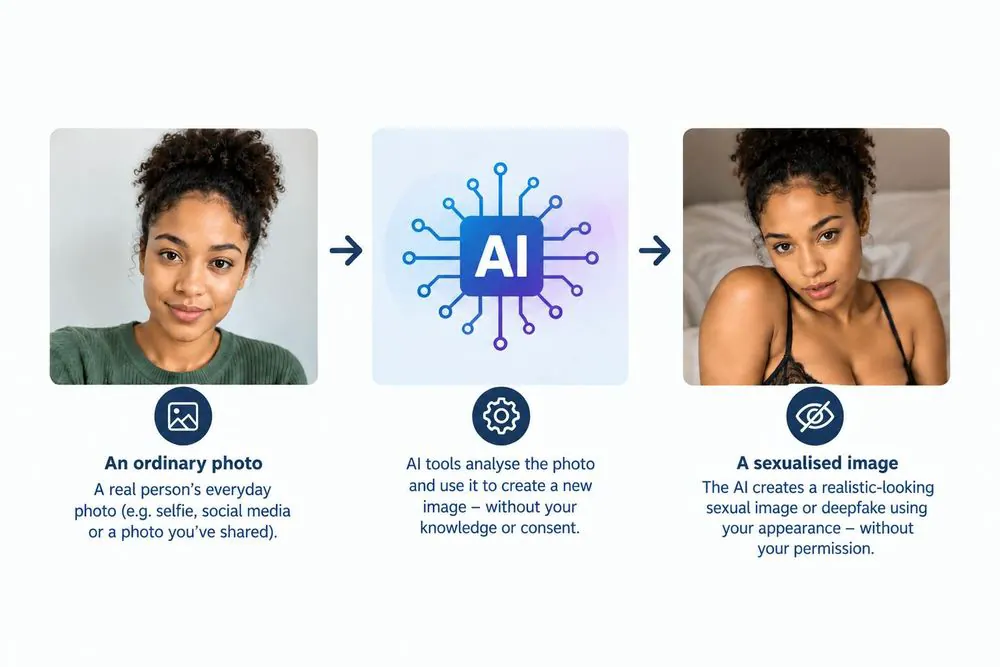
The rise of AI-powered nudifying apps is turning ordinary photographs into non-consensual explicit images in seconds, sparking an urgent debate among cyber law and digital media experts over the adequacy of South African legislation. These experts gathered for a Film and Publication Board (FPB) webinar to discuss the dangers of generative AI and nudifying apps. The technology enables rapid creation and manipulation of digital content, bringing innovation alongside systemic risks like synthetic media and non-consensual imagery.
Generative AI allows for the creation of AI-generated sexual images from ordinary photographs without the subject's consent. Distinguishing authenticity from AI-generated material is increasingly difficult for platforms and regulators, as existing moderation mechanisms lag behind advancing technologies. AI-powered nudifier apps target prominent figures, including musician Taylor Swift, and require a real person's image, often just a face, which AI superimposes onto a regenerated body created through diffusion and inpainting models.
Experts call for a multi-layered governance model encompassing regulation, safety by design, digital literacy, and cross-sector cooperation to strengthen safeguards across the entire content lifecycle. University of the Witwatersrand senior lecturer in Cyber Law, Dr. Nomalanga Mashinini, questioned how constitutionally protected personality rights, such as privacy, identity, and human dignity, are impacted under South African and African law when photos can be turned into non-consensual sexual images for free in under a minute.
Dr. Mashinini explained that the real harm begins from the moment someone uses a person's image without their knowledge or permission, as many nudifying apps are used by individuals to create porn using the image of someone they like. Werksmans Attorneys Digital Media and Electronic Communications Head, Wendy Rosenberg, stated that nudifying apps are affecting children and are rampant in schools, causing real harm.
Rosenberg noted that South Africa has a level of legal protection in place, including the Film and Publication Board Act (FPB Act), which prohibits exposing private sexual photos without consent and penalizes knowing distribution of private sexual photos without consent. However, the legislation typically lags behind technology and lacks a general prohibition on developing or distributing nudifying apps/sites themselves.
The Cybercrimes Act and Electronic Communications and Transactions Act (ECT Act) also provide mechanisms for dealing with non-consensual sharing of intimate images and prohibited online content. Rosenberg emphasized the need for a multi-layered collaborative approach, including digital literacy, cooperation, collaboration, information sharing, and enforcement, to address the issue.
Experts stress that the problem requires a comprehensive approach, involving various stakeholders, to strengthen safeguards and protect victims. The FPB and other organizations must work together to address the issue, which is not limited to South Africa but also affects the broader African region.
Key points
- AI-generated sexual images can be created from ordinary photographs without the subject's consent.
- Experts call for a multi-layered governance model to strengthen safeguards.
- South African legislation lags behind technology in addressing non-consensual sharing of intimate images.