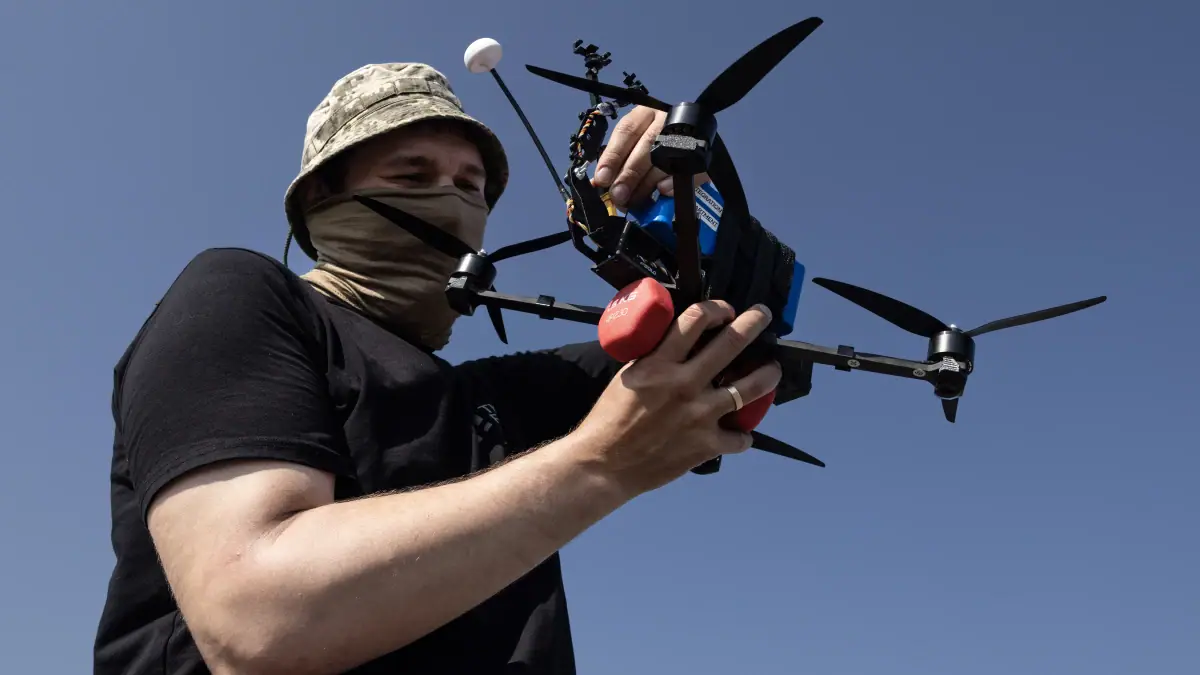
The ongoing conflict in Ukraine has witnessed a significant shift in warfare tactics with the deployment of artificial intelligence (AI)-enabled drones. Yaroslav Azhnyuk, a 37-year-old computer scientist, turned to developing drone warfare after Russia's 2022 invasion. His company, The Fourth Law, is among the top producers of AI-powered drones in Ukraine, with dozens of military units already using their autonomous drone, Lupynis-10-TFL-1. Azhnyuk believes AI makes drones faster and more capable, providing an asymmetric advantage.
Azhnyuk's company, The Fourth Law, and another firm, Odd Systems, are leaders in autonomous drones and thermal cameras. The Lupynis TFL-1 drone combines a small, affordable first-person-view (FPV) drone with an autonomous terminal guidance unit. This drone has an onboard computer and AI technology that takes control during the last 500 meters of flight. Azhnyuk's background is in Silicon Valley, where he developed smartphone-powered cameras that use AI to watch and entertain pets. After the Russian invasion, he pivoted to the defense space to protect his country.
The autonomous Lupynis TFL-1 drone is named after the 20th-century Ukrainian poet and political activist Anatoliy Lupynis. The company has named all its weapons after Ukrainian intellectuals and artists killed or persecuted by Russians in the last century. Azhnyuk says it is essential to help resurrect these individuals, and their ideas are still relevant today. The drones are part of a high-tech arms race that has many worried, including Ukrainian President Volodymyr Zelenskyy, who has warned that AI could lead to decisions on the battlefield as soon as next year.
The Fourth Law teams test the Lupynis TFL-1 drones daily, using a fold-out table and a copse of trees as a makeshift testing site. The team, led by a man with the military call sign Stab, demonstrates the drone's capabilities. The drone begins its flight guided by a pilot, who navigates it with a control stick and selects a target. The drone then locks onto its target and flies itself to the location, using a deep-learning neural network to recognize targets.
According to Stab, AI drones are useful because they are hard to jam, and safeguards are in place to prevent them from going rogue. Humans select the target, ensuring that the drones do not make autonomous decisions. Azhnyuk acknowledges concerns over destructive weapons but believes that AI is not the primary issue. He compares AI to fire or steel, stating that any tool can be used for good or bad, and it is the human who decides how to use it.
Azhnyuk emphasizes that his company's AI-powered drones are not killer robots and are far from a Terminator-like scenario. However, he does acknowledge that AI is developing quickly, and it is not unthinkable that future drones could make their own decisions on designating targets. Azhnyuk's primary focus is on what Ukraine needs today, and he believes that if Ukraine refuses to use AI in decision-making in a defensive scenario, they will lose to adversaries using AI for decision-making in an offensive scenario.
The development of AI-powered drones in Ukraine has raised concerns about the ethics of AI in warfare. Azhnyuk believes that the most important thing is to survive, and if Ukraine loses, there will be no opportunity to discuss the ethics of AI. The use of AI in drones has transformed the way wars are fought, and it is likely that this technology will continue to play a significant role in future conflicts.
Key points
- Ukrainian companies are developing AI-powered drones to counter Russian invasion.
- AI drones provide an asymmetric advantage on the battlefield.
- The development of AI-powered drones raises concerns about the ethics of AI in warfare.