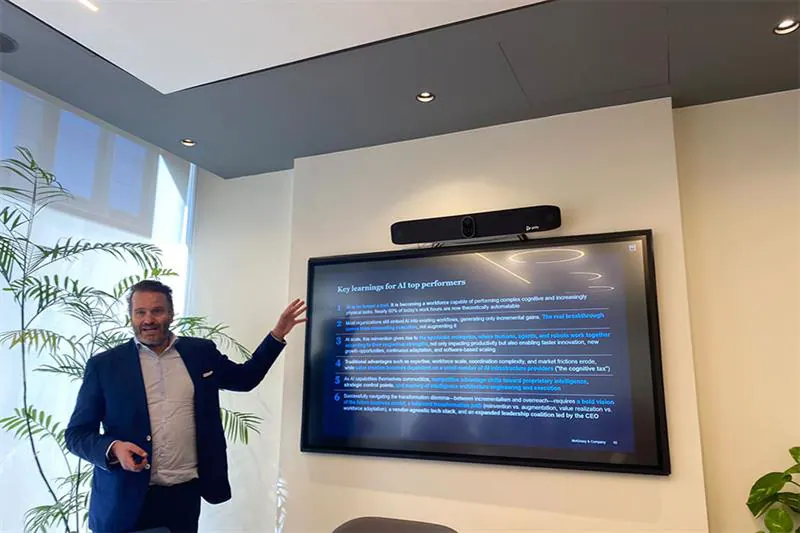
Egypt could be approaching an economic inflection point where artificial intelligence and the digital economy help accelerate development, according to Tamim Saleh, Senior Partner and Managing Partner for Cairo at McKinsey & Company. Saleh believes that AI can help compress decades of economic development into a shorter period, but this will require significant investment, computing capacity, reliable connectivity, energy, and skilled talent. This was stated during a roundtable discussion at McKinsey's Cairo headquarters for selected Egyptian journalists.
Historically, economic transformations have taken generations to unfold, as seen in the cases of China, South Korea, and Singapore. Saleh notes that rapid development typically requires years of investment in productive capital, infrastructure, and local capabilities. However, AI technologies are developing and spreading at an unprecedented speed, potentially changing the rules of the game. Technology diffusion is accelerating rapidly, with expectations around AI capabilities changing dramatically in just a few years.
Saleh emphasizes that Egypt's opportunity is not just about creating an AI industry for foreign currency through technology sales and exports. Rather, the bigger opportunity lies in using technology to improve productivity across the wider economy and accelerate Egypt's transition to a digital economy. He points to the growing share of economic activity being delivered digitally, including banking, education, and services. AI-enabled work could further accelerate this transition as companies adopt AI tools.
For Egypt to seize this opportunity, it must overcome several fundamental infrastructure constraints, including investment, connectivity, computing capacity, and energy. Saleh stresses the importance of reliable connectivity, trusted computing infrastructure, and sovereign cloud capabilities to support growing demand for AI applications. He also highlights the need for data cleansing and integration, large language models, and agentic AI as components of digital infrastructure.
Egypt could become a data-centre hub, according to Saleh, with foreign companies looking at Egypt as a destination for technology investment, including data centres and software development. Egyptian companies are also taking steps to expand the country's digital infrastructure. Egypt's geographic position and connectivity could allow it to build data-centre capacity to serve domestic demand and export digital services and computing capacity to international markets.
Saleh notes that Egypt's position as a major international connectivity route is another potential advantage, with around 17 percent of global data flows passing through Egypt. Developing data centres for export markets could generate significant foreign-currency revenues, potentially up to $60 billion. However, this figure requires further research and validation.
Talent is another major advantage for Egypt, with Saleh describing the country's talent pool as a significant asset. Technology is changing the opportunities available to young Egyptians by allowing them to provide services. With the right infrastructure and human capabilities in place, Egypt could be well-positioned to capitalize on the opportunities presented by AI and the digital economy.
Key points
- Egypt may be on the verge of an economic inflection point driven by AI and digital economy.
- AI can help compress decades of economic development into a shorter period.
- Egypt needs to invest in infrastructure, including computing capacity, reliable connectivity, and energy, to seize the opportunity.