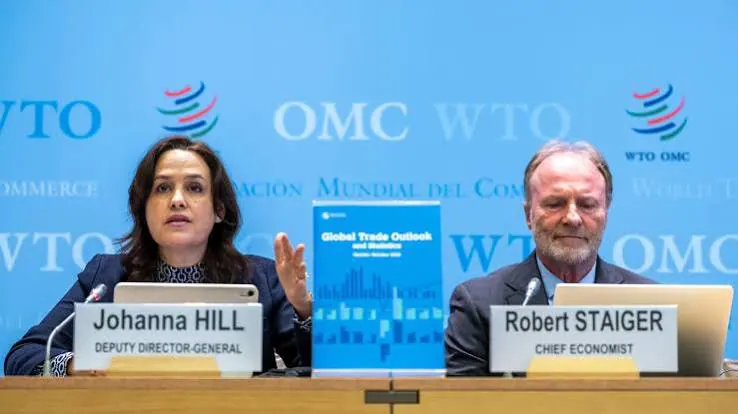
The World Trade Organization (WTO) has upgraded its forecast for global merchandise trade growth in 2026 to 3.9%, up from 1.9%, citing the artificial intelligence investment boom as a key driver. This growth is expected to create fresh opportunities for exporters, despite elevated energy and shipping costs. The revised projection, published on October 8, represents a two percentage-point upgrade from the WTO's March forecast.
The stronger outlook is largely driven by investment in AI infrastructure, which has boosted demand for semiconductors, servers, and other technology-related goods. Trade in AI-enabling products increased by 67% year-on-year, with such goods accounting for 47% of merchandise trade growth in the first half of 2026. Global investment in AI infrastructure is projected to increase by at least 30% this year, with capital expenditure expected to rise by another 10-20% in 2027.
The technology-driven expansion has helped cushion the impact of the Middle East conflict, which disrupted energy supplies and important shipping routes. Crude oil exports from the region fell by about 24% in the first half of the year, while liquefied natural gas shipments declined by 47%. Alternative supplies limited the reduction in global crude exports to around 6% and LNG exports to 1%.
The recovery, however, is uneven across regions. Asia is expected to lead merchandise export growth at 9.9% in 2026, followed by North America at 5.7% and Africa at 5.6%. South America is projected to grow by 3.4%, while Europe's exports are forecast to contract by 0.1%. Africa's imports are expected to rise by 8.9%, reflecting expanding trade activity.
For Nigeria, the projections come amid an expanding merchandise trade position. National Bureau of Statistics data show that total trade rose to N41.44 trillion in the second quarter of 2026, with exports accounting for N27.02 trillion and imports N14.42 trillion. The resulting trade surplus stood at N12.60 trillion.
The challenge for Nigeria is to ensure that it captures a larger share of the opportunity through stronger non-oil exports, local processing, and greater participation in regional and global value chains. While crude oil and gas remain important sources of export earnings, agricultural products, processed foods, solid minerals, and manufactured goods offer scope to diversify foreign exchange receipts.
WTO Director-General Ngozi Okonjo-Iweala noted that the resilience of global supply chains had helped keep essential products moving despite disruptions, but warned that access to emerging opportunities such as AI remained uneven. For Nigeria, the improved global trade outlook will not automatically translate into stronger export earnings or jobs, and businesses must overcome high logistics costs, infrastructure constraints, and limited access to finance to compete in expanding markets.
Key points
- The World Trade Organization raises its forecast for global merchandise trade growth in 2026 to 3.9%, driven by AI investment boom.
- Nigeria's total trade rose to N41.44 trillion in the second quarter of 2026, with exports accounting for N27.02 trillion and imports N14.42 trillion.
- Africa's exports are projected to grow by 5.6% in 2026, with Nigeria seeking to capture a larger share of the opportunity through stronger non-oil exports.