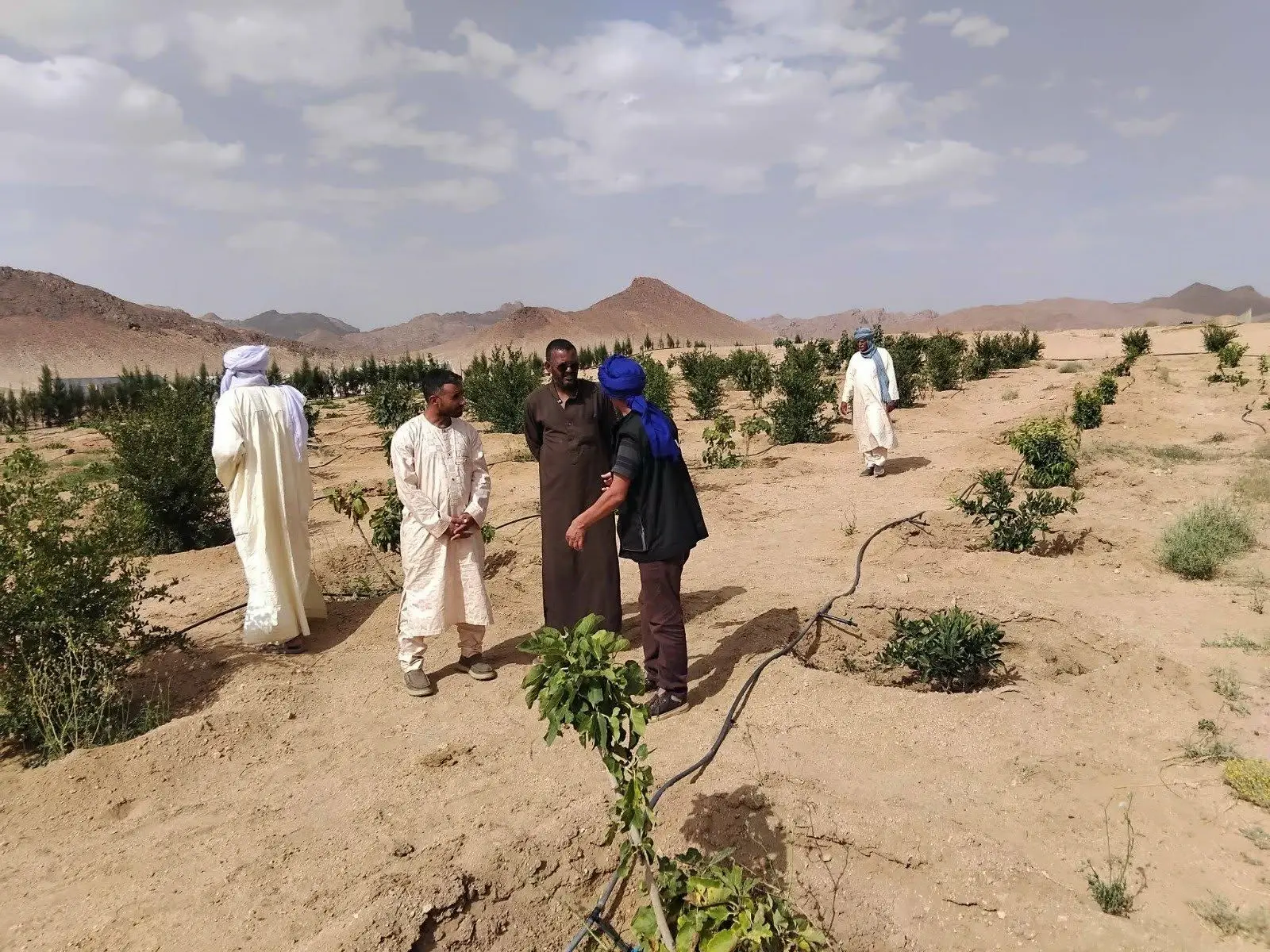
The commune of Tazrouk in Algeria's Tamanrasset province has witnessed significant growth in agricultural activities in recent years. The region, located over 1,800 meters above sea level, has seen an increase in arboriculture, with young people showing growing interest in the sector. The local agricultural services report that the total agricultural area in Tazrouk is approximately 620 hectares, with around 300 hectares being useful agricultural land. Most of the cultivated land is situated along the banks of oueds.
Tazrouk's climate is characterized by cold winters and mild summers, with limited rainfall. As a result, agriculture in the region relies heavily on irrigation from agricultural boreholes. The commune has 496 agricultural exploiters, with an average of about 0.5 hectares per exploitation. Fruit tree cultivation is one of the most dynamic agricultural sectors in the region, with vineyards, apricot, and peach trees being prominent. The local agricultural services report that 6,235 quintals of fruits were produced during the 2025-2026 season.
The agricultural sector in Tazrouk has seen significant progress in recent years, driven by improved groundwater levels and incentives for farmers. Cereal production reached 280 quintals, while vegetable production was estimated at 1,000 quintals. The production of fodder reached approximately 7,720 quintals during the same period. In addition to agriculture, livestock farming is a crucial part of the local economy, with 9,932 sheep, 11,250 goats, and 3,100 camels.
To support farmers, the local authorities have implemented several initiatives. Over 300 agricultural exploitations have been connected to the electricity grid, which accounts for about 60.48% of the total exploitations. Farmers also receive support with their electricity bills, with half of the costs covered. Additionally, the authorities provide farmers with pumps, livestock feed, and fruit trees, and promote modern irrigation techniques such as drip irrigation and sprinkling.
The local agricultural services, in collaboration with the agricultural chamber and national institutes, organize training and extension programs for farmers. These programs aim to improve agricultural practices and introduce new techniques. The authorities also undertake measures to protect cultivated land from erosion caused by oued floods during the rainy season.
Efforts are being made to diversify agricultural activities in Tazrouk. Trials are underway to introduce olive and almond cultivation to the region. These new crops have shown promise, and their introduction could provide new opportunities for local farmers. The development of these new crops, combined with the expansion of fruit tree cultivation and the adoption of water-efficient irrigation techniques, is expected to contribute to increased production and better use of available land.
Despite the progress made, the agricultural sector in Tazrouk faces several challenges, including drought and declining groundwater levels. The region's mountainous terrain and high altitude also pose difficulties for farmers. The local authorities and agricultural services are working to address these challenges by providing support to farmers and promoting sustainable agricultural practices. The sector's growth is crucial to the local economy, and efforts are being made to ensure its continued development.
Key points
- The commune of Tazrouk has seen significant growth in agricultural activities, with 496 agricultural exploiters and a total agricultural area of approximately 620 hectares.
- Fruit tree cultivation is a dynamic sector in Tazrouk, with 6,235 quintals of fruits produced during the 2025-2026 season.
- The local authorities are implementing initiatives to support farmers, including providing access to electricity, pumps, and modern irrigation techniques.