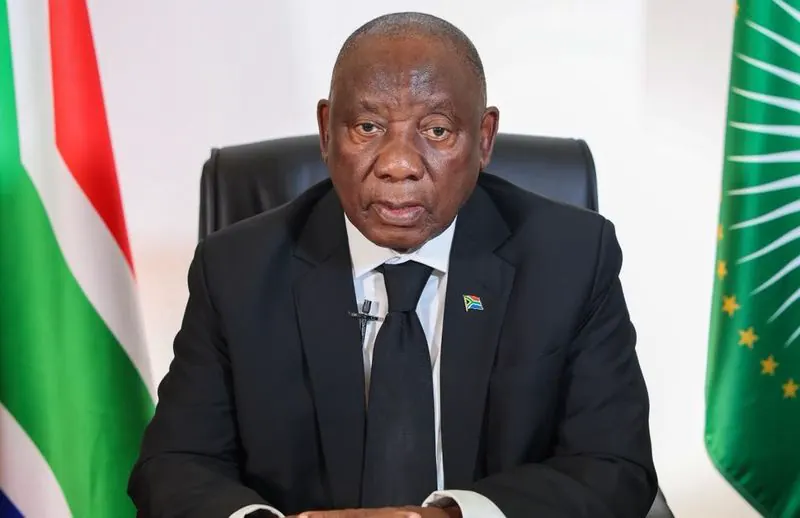
The African Union has decided to support South Sudan's first democratic elections on December 26, despite concerns that the current conditions are unfavorable and could lead to further violence. The AU's C5 committee on South Sudan, chaired by President Cyril Ramaphosa, held a virtual meeting on September 29 to review the country's readiness for elections. The committee includes representatives from Algeria, Chad, Nigeria, and Rwanda, with Ramaphosa being the only president of the C5 members present.
South Sudan's President Salva Kiir and the deputy chairperson of the AU Commission, Selma Malika Haddadi, also attended the meeting. Haddadi stated that the South Sudan government has expressed its commitment to holding elections on December 26 and that it is essential to maintain momentum. However, Ramaphosa emphasized that the committee is aware of the many challenges and significant work that still needs to be done. He noted that transitioning to democracy requires more than just elections and that the conditions for free, fair, and credible polls must be created.
The committee recommended that all parties comply with the 2018 Revitalised Peace Agreement and demonstrate their commitment to its full implementation. They also urged the government to release all persons arbitrarily detained on political grounds and guarantee the rights and humane treatment of persons facing judicial proceedings. Furthermore, the committee suggested that the government adopt a feasible, consensual, and time-bound electoral roadmap that clearly sets out the legal basis, scope, and sequencing of elections.
One of the main obstacles to free and fair elections is the house arrest of First Vice-President Riek Machar by President Kiir last year. Several other political opponents are also in detention, raising concerns that Machar's supporters could violently disrupt the elections. Ramaphosa stated that the primary responsibility for implementing the agreed measures lies with the government and parties of South Sudan, but the C5 countries and the AU will support South Sudan.
Researchers at the Institute for Security Studies in Nairobi have expressed concerns that credible elections are no longer possible in South Sudan and have recommended postponing elections until the right conditions are created. They noted that President Kiir has undermined the power-sharing arrangement through unilateral cabinet dismissals and delays in security sector reforms. If Kiir pushes ahead with polls, the outcome will be an illegitimate political dispensation that deepens instability.
Despite these concerns, the AU has decided to press ahead with the elections, hoping to help create the necessary conditions in less than three months. The AU, C5, and Igad (the Inter-Governmental Authority on Development) will coordinate voluntary and needs-based technical assistance in support of the electoral process and the implementation of the Revitalised Peace Agreement. Ramaphosa appealed to the international community to support South Sudan in this endeavor.
The international community and local stakeholders will be watching closely as South Sudan prepares for the elections. The success of the polls will depend on the government's ability to address the significant challenges and obstacles that remain. The African Union's support for the elections is seen as a crucial step towards consolidating peace and stability in the region.
Key points
- The African Union supports South Sudan's December 26 elections despite concerns over the country's readiness.
- President Cyril Ramaphosa cautions that significant obstacles threaten credible polls in South Sudan.
- The African Union's C5 committee recommends that all parties comply with the 2018 Revitalised Peace Agreement to ensure a credible electoral process.