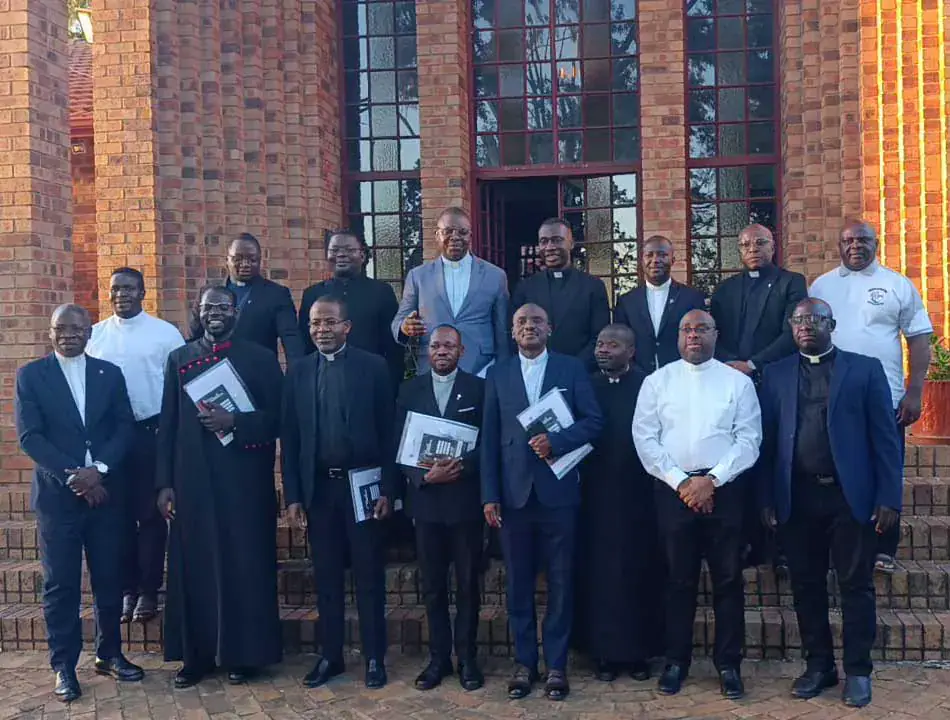
Seminary rectors from across the Inter-Regional Meeting of Bishops of Southern Africa (IMBISA) region have gathered at the Padre Pio Retreat Centre in the Archdiocese of Pretoria. The African Synodality Initiative workshop on synodality curriculum development began on Tuesday, 27 October, and will conclude on Friday, 30 October. The workshop brings together rectors and formators from seminaries across the region to reflect on the meaning of synodality and consider practical ways of embedding its principles in seminary formation.
Participants represent several episcopal conferences, including the Conferência Episcopal de Angola e São Tomé (CEAST), the Lesotho Catholic Bishops’ Conference, the Episcopal Conference of Mozambique (CEM) and the Zimbabwe Catholic Bishops’ Conference. The workshop comes as the Catholic Church continues implementing the vision of a synodal Church, emphasising communion, participation and mission. Its focus is on preparing future priests not only to understand synodality theologically, but also to practise it in their pastoral leadership and ministry.
Jesuit Father Agbonkhianmege E. Orobator joined participants virtually to introduce the Synod on Synodality and its implications for the life of the Church. Father Orobator, a Nigerian theologian and former president of the Jesuit Conference of Africa and Madagascar, participated as a voting member of the 2023 and 2024 assemblies of the Synod of Bishops on synodality. He currently serves as dean of the Jesuit School of Theology at Santa Clara University in California.
Drawing on the Synod’s Final Document, For a Synodal Church: Communion, Participation, Mission, Father Orobator highlighted the statement that synodality is the Church’s ordinary way of living and working. He invited participants to reflect on what this means for the Church and, in particular, for those responsible for forming future priests. The challenge, he suggested, is to move beyond treating synodality as a newly introduced programme or an occasional pastoral activity and instead recognise it as a way of being Church.
Father Marcel Uwineza SJ led participants in an exploration of synodality as a constitutive dimension of the Church, with particular attention to its place in seminary formation. Father Uwineza is a theologian and the principal of Hekima University College, a Jesuit institution in Nairobi, Kenya. He holds a doctorate in systematic theology from Boston College and has written extensively on theology, reconciliation, Christian anthropology and the experience of post-genocide Rwanda.
Another key element of the programme was the practice of Conversation in the Spirit, a method of prayerful listening and communal discernment that featured prominently in the Synod on Synodality. Father Orobator introduced the method, while Ms Caroline Kavita from the African Synodality Initiative demonstrated its practice. Father Uwineza then facilitated group work using the approach. Conversation in the Spirit invites participants to reflect prayerfully, listen attentively to one another and discern what the Holy Spirit may be communicating through their shared experiences.
The four-day gathering provides an opportunity for seminary leaders to consider how the Church’s synodal vision can become an integral part of priestly formation across the IMBISA region. The discussions are taking place within the wider implementation of the Synod’s Final Document, which calls for local Churches to develop formation initiatives appropriate to their cultural and pastoral contexts.
Key points
- The African Synodality Initiative workshop aims to integrate synodality into priestly formation across the IMBISA region.
- Jesuit Father Agbonkhianmege E. Orobator introduced the Synod on Synodality and its implications for the life of the Church.
- The workshop focuses on preparing future priests to lead communities in which synodality is an ordinary way of life.