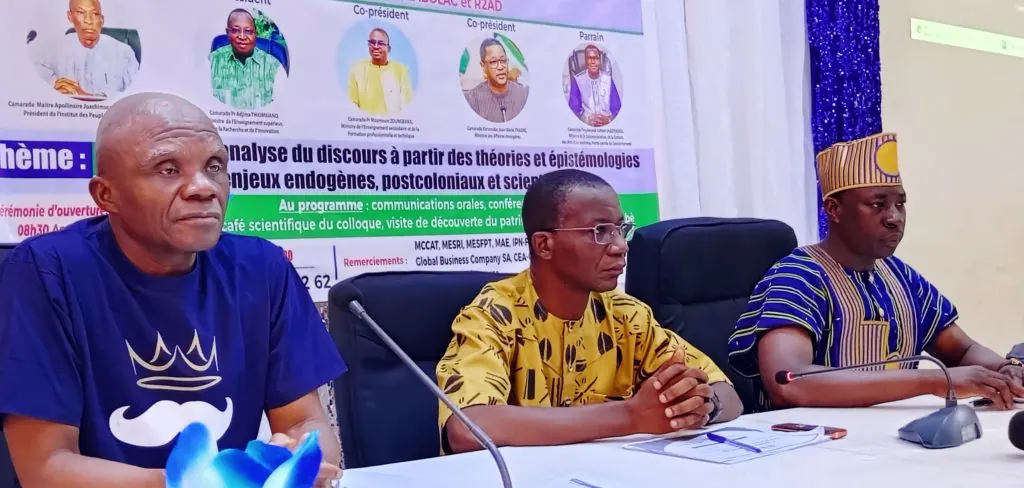
The 2nd international colloquium of the Observatory for Production and Analysis of Discourse (OPAD) concluded in Ouagadougou on September 25, 2026. The two-day event brought together researchers, teachers, and students from nine countries to discuss theories and epistemologies in African contexts. The theme, "Rethinking Discourse Analysis from African Theories and Epistemologies," guided the presentations and discussions of around 100 communications. The diversity of approaches and quality of communications were notable highlights.
The colloquium featured various approaches, including logometry, enunciative analysis, pragmatic and polyphonic approaches, and analysis of religious and political discourses. Researchers presented and discussed their work, focusing on endogenous, postcolonial, and scientific issues. The general report, structured around six axes, showcased the range of methods employed. Notably, Pr Djédjé Hilaire Bohui proposed an African communication approach, comprising five stages: communicative intention, verbal chain, entry point, cultural competence, and technological competence.
Pr Sidiki Traoré, president of the scientific committee, emphasized the significance of this approach and the kémiotique approach developed by Pr Mahamadou Lamine Ouédraogo. Traoré highlighted that African terrain offers numerous opportunities for scientific renewal, stressing that Africa should no longer be merely a subject discussed by others. Instead, Africans should discuss themselves using their own tools. He encouraged African researchers to become "consom'acteurs" (producers and consumers) of scientific production.
The OPAD aims to sustain this reflection over time. Dr Boukary Nebié, president of the organizing committee, expressed satisfaction with the event's success, citing the number of communications, international participation, and presence of renowned researchers. He announced plans for a third edition in 2028, with ambitions to further expand international participation. The colloquium demonstrated that African researchers are committed to developing contextual tools and approaches.
Pr Djédjé Hilaire Bohui emphasized the importance of researchers appropriating their history, concepts, and tools based on their unique perspective. He noted that all creations, including research, bear a significant cultural mark. Bohui hoped that exchanges among researchers would lead to the development of operational tools adapted to African contexts. The OPAD seeks to continue this discussion, moving beyond the application of existing models to producing new knowledge from African realities.
The event brought together scholars from diverse backgrounds, fostering a rich exchange of ideas. Participants presented and discussed their research, contributing to a deeper understanding of discourse analysis in African contexts. The colloquium's outcomes will likely influence future research, as scholars strive to develop more nuanced and contextual approaches.
The OPAD's initiative has sparked a crucial conversation about the need for contextual tools in discourse analysis. As researchers continue to explore and develop new approaches, the impact on various fields of study is expected to grow. The colloquium's success underscores the importance of sustained dialogue and collaboration among scholars from diverse backgrounds.
Key points
- African researchers are advocating for the development of contextual tools and approaches in discourse analysis.
- The OPAD colloquium brought together scholars from nine countries to discuss theories and epistemologies in African contexts.
- Researchers presented and discussed around 100 communications, showcasing diverse approaches and methods.