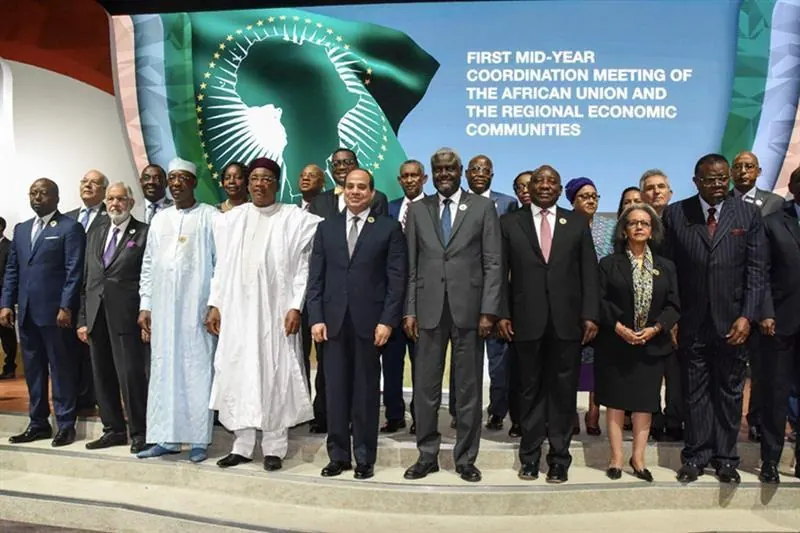
African leaders have renewed their commitment to accelerating continental integration, strengthening regional cooperation, and turning the ambitions of Agenda 2063 into measurable economic progress. This commitment was made during the Eighth African Union Mid-Year Coordination Meeting, held on October 4, 2026, in El-Alamein, Egypt. The meeting brought together African heads of state and government, the African Union Commission, Regional Economic Communities, and Regional Mechanisms.
The meeting emphasized making Africa's economic integration more productive, with AU Chairperson and President of Burundi, Évariste Ndayishimiye, arguing that establishing a continental free-trade area alone would not be enough. Africa must also strengthen its capacity to produce, transform, and add value to its resources within the continent. This message is at the heart of Africa's economic transformation agenda, which seeks to increase production, expand manufacturing, develop regional value chains, and move goods efficiently across borders.
The African Continental Free Trade Area (AfCFTA) offers the continent an enormous potential market, but its impact depends on whether African economies can increase production, expand manufacturing, and develop regional value chains. To achieve this, the meeting called for stronger investment in infrastructure, technology transfer, productive capacity, and intra-African trade. Leaders highlighted the importance of interconnected roads, railways, energy networks, ports, and digital infrastructure in enabling people, goods, and services to move more efficiently across the continent.
Trade facilitation was another priority, with the meeting calling for continued efforts to remove unjustified and unnecessary non-tariff barriers, strengthen cross-border payment systems, and improve conditions for African businesses to trade across markets. Small and medium-sized enterprises were identified as important participants in the integration process, with the AU encouraging African businesses to invest more in innovation, production, and value addition.
For Africa's private sector, the opportunity is substantial, with a more connected continental market allowing businesses to move beyond national markets, build regional supply chains, and reach consumers across multiple economies. However, for governments, integration requires more than agreements; it requires implementation. The AU meeting reaffirmed the importance of coordination between the continental body, Regional Economic Communities, Regional Mechanisms, and individual member states.
The meeting's emphasis on productive capacity is particularly important, as Africa's long-term economic transformation will depend not only on exporting raw materials but on processing more of its agricultural, mineral, and energy resources within the continent. This shift could create jobs, strengthen local industries, deepen supply chains, and retain more value within African economies. The message from El-Alamein is both strategic and practical: integration must increasingly translate into production, investment, trade, and shared infrastructure.
As countries continue implementing the AfCFTA and Agenda 2063, the challenge will be turning political commitments into projects that businesses and citizens can see and use. The latest AU meeting provides renewed momentum, with the next measure of success being how quickly that momentum becomes connected markets, stronger industries, and greater intra-African trade. The African Leadership Magazine has announced winners for the 2025 African Business Leadership Awards, highlighting excellence in economic policy, private sector advocacy, and entrepreneurship.
Key points
- African leaders reaffirm commitment to continental integration and economic progress.
- Establishing a continental free-trade area is not enough; Africa must strengthen its capacity to produce, transform, and add value to its resources.
- The African Continental Free Trade Area offers an enormous potential market, but its impact depends on whether African economies can increase production, expand manufacturing, and develop regional value chains.