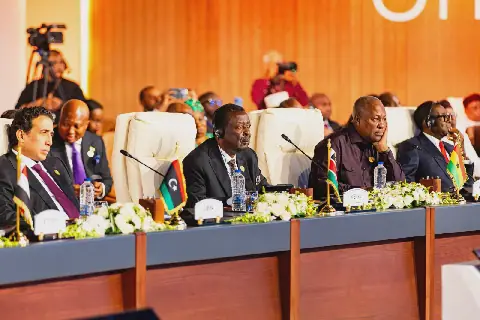
African leaders converged at the inaugural Alamein Africa Forum, held at a historic battlefield, to discuss the continent's persistent challenge of turning plans into completed projects. The forum brought together the African Union Commission chair, two heads of state, the continent's most powerful development banker, and its richest industrialist. They emphasized that Africa has never lacked vision but has consistently struggled with the capacity to transform visions into tangible projects. The leaders acknowledged that the age of declarations is over and that it's time for action.
The African Union Commission Chairperson, Mahmoud Ali Youssouf, set the tone for the forum by highlighting Africa's lack of capacity to turn visions into projects that are prepared, financed, built, and completed. The AU's response is to bring governments and the private sector together, recognizing that neither can deliver alone. Burundi's President Évariste Ndayishimiye, the current AU Chairperson, offered a sharp diagnosis, noting that Africa is resource-rich yet insufficiently transformed. He cited the paradox of Africa importing food it can grow and medicines it can make while its raw materials are processed elsewhere.
President Ndayishimiye proposed an African Investment and Implementation Dashboard to track continental projects, their financing, responsible parties, timelines, and measurable results. This tool would put names, dates, and money against every promise, making it a significant departure from the typical communiqués with no consequences that often follow African summitry. The leaders also discussed the African Continental Free Trade Area (AfCFTA), with Ndayishimiye listing the agreement's shortcomings, including trade corridors, integrated border posts, harmonized customs, and logistics.
Egypt's President Abdel Fattah El-Sisi, who hosted the forum, tied economic progress to peace, stability, strong institutions, and respect for sovereignty. He emphasized the need for better information on opportunities in neighboring markets, which is a significant gap that stifles intra-African trade. Aliko Dangote, Africa's richest industrialist, made a compelling economic case, arguing that a factory serving 30 million consumers is a different investment proposition than one that can reach hundreds of millions. He highlighted the "African scale penalty" that businesses face due to fragmentation.
Afreximbank President George Elombi delivered a politically charged intervention, urging governments to capitalize African institutions, honor their legal commitments, and defend their creditor status. He argued that these institutions should be judged on their substance, performance, and ownership, rather than against methodologies designed for different institutional models. Elombi appealed to governments to defend African institutions, stating, "This bank is your bank. Please defend it."
AUDA-NEPAD CEO Nardos Bekele-Thomas provided the arithmetic of delivery, emphasizing that Africa suffers not from a shortage of meetings but from a shortage of deals and execution. She called for blended finance, serious project preparation, regional projects, and greater mobilization of African pension and sovereign wealth funds. Bekele-Thomas set a deadline, stating that by the time the forum reconvenes in 2028, Africa should be able to show projects that have moved from preparation to investor-ready status and beyond.
The forum's outcome will be tested by three key factors: the establishment of the proposed dashboard, the mobilization of African capital, and the fixing of AfCFTA's infrastructure. The leaders' rhetoric was coherent and courageous, but the real challenge lies in implementation. The 2028 gathering will determine whether Alamein becomes a turning point or a postscript. Until then, the promise made by Africans to themselves in public remains a commitment to transform the continent's future.
Key points
- The African leaders proposed a public dashboard to track continental projects, their financing, and measurable results.
- The leaders emphasized the need for a change in the kind of relationships Africa pursues, from diplomatic partnerships to economic and production partnerships.
- The implementation of the African Continental Free Trade Area (AfCFTA) was discussed, with leaders highlighting the need to address its shortcomings, including trade corridors and logistics.