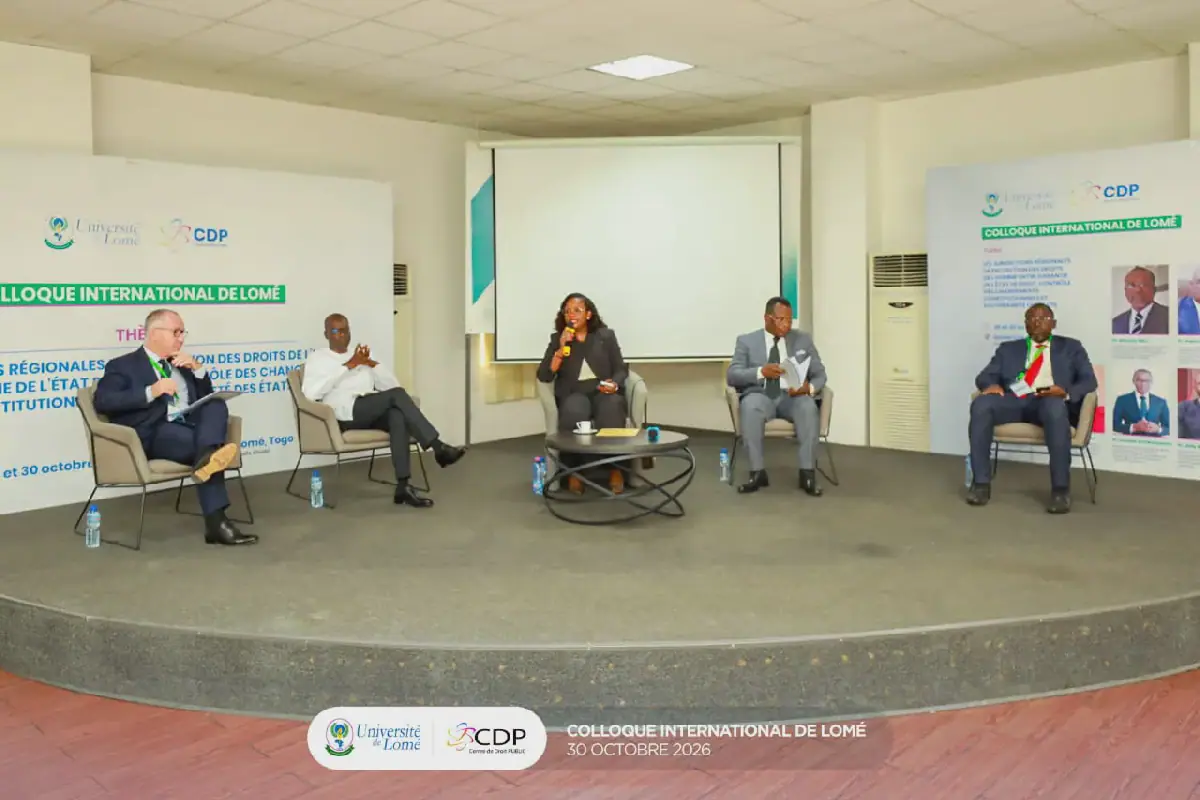
The University of Lomé recently hosted an international colloquium on regional jurisdictions, organized by the Center for Public Law (CDP). The event brought together experts to discuss the balance between guaranteeing the rule of law and respecting state sovereignty. The first day of discussions set the tone, with experts highlighting the crisis of existentiality facing the ECOWAS Court. Former judge Alioune Sall emphasized the political reality that member states, as creators of treaties, maintain control over the institution.
Professor Fabrice Hourquebie from the University of Bordeaux noted that regional law takes precedence unless it infringes on a state's core sovereignty. He argued that the ECOWAS Court has ignored this limit, particularly in its past attempts to block constitutional revisions. Hourquebie emphasized the need for a balance between state obligations and judicial respect for those obligations. The colloquium also examined the recent case of Togo's 2024 constitutional revision and the ECOWAS Court's January 29, 2026 ruling.
Professor Joseph Junior Kodjo highlighted the functional limitations of the ECOWAS Court, stating that it is not a constitutional court but rather a regional law court. While it can address constitutional questions through treaties, its control is limited to conventional matters. However, the January 29, 2026 ruling demonstrated that the Court has overstepped its authority. Professor Dandi Gnamou, a judge at the Benin's Constitutional Court, argued that the ECOWAS Court exercised "competence without title" in the Togo case.
Gnamou emphasized that no provision in the 1993 treaty, 1991 protocol, or 2005 protocol grants the ECOWAS Court authority to assess the validity of a constitutional law. The Court circumvented this limitation by using a "control by ricochet" approach via human rights. However, this method leads to an impasse, as the Court lacks the power to annul or order the withdrawal of the constitutional revision. Dr. Christian Trimua from the University of Lomé pointed out another inconsistency in the ruling's drafting.
Trimua noted that the ruling was written in English, while the judges based their decision on the French version of Article 23 of the African Charter on Democracy (CADEG). He highlighted a significant semantic confusion between the French and English versions of the article. Trimua also criticized the Court's inconsistent jurisprudence, citing its different approaches in Guinea (Diallo ruling, 2024) and Togo.
The consequences of the ECOWAS Court's actions have been swift. The Court's greffier en chef sent a letter to the Togolese Minister of Justice, requesting implementation of the ruling. However, states have resisted, and Trimua noted that Togo sometimes executes decisions but questions the extent of its consent. The debate concluded with a clear message: the ECOWAS Court must demonstrate realism and respect for state consent to survive.
Professor Dandi Gnamou emphasized that states will not accept the Court's decisions without their consent. She advocated for an "obligation of loyal cooperation" and a "pluralism ordonné" to coordinate different legal orders. The colloquium's outcome is clear: the ECOWAS Court must find a balance between pragmatism and respect for state autonomy to maintain its relevance.
Key points
- The ECOWAS Court has overstepped its authority in the Togo constitutional revision case.
- Experts argue that the Court must demonstrate realism and respect for state consent to survive.
- The Court's actions have led to resistance from states, which question the extent of their consent.