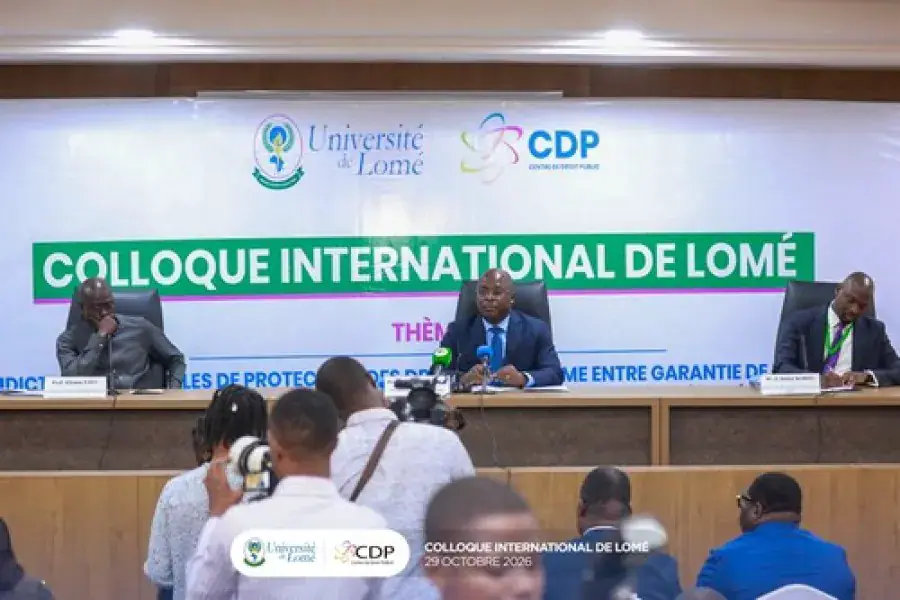
The University of Lomé recently hosted an international colloquium on regional jurisdictions, organized by the Center for Public Law (CDP). The event brought together experts to discuss the balance between guaranteeing the rule of law and respecting state sovereignty. The colloquium focused on criticizing the inconsistencies of the ECOWAS Court of Justice, particularly its January 29, 2026, ruling against Togo. Experts argued that the court's actions have sparked concerns about its overreach and potential erosion of state sovereignty.
The colloquium's inaugural lecture was delivered by former judge Alioune Sall, who emphasized the political reality that member states, as creators of treaties, maintain control over the institution. Professor Fabrice Hourquebie from the University of Bordeaux noted that regional law takes precedence unless it infringes upon a state's core sovereignty. He argued that the ECOWAS Court has ignored this limit, leading to a breach of loyal execution. Hourquebie emphasized the need for a balance between state obligations and judicial respect for those obligations.
The colloquium examined the case of Togo's 2024 constitutional revision and the subsequent ECOWAS Court ruling. Professor Joseph Junior Kodjo highlighted the functional limitations of the Abuja court, stating that it is not a constitutional court but rather a regional law court. He argued that the court can only exercise conventional control when seizing constitutional questions via treaties. However, the January 29, 2026, ruling demonstrated that the court has taken liberties beyond its mandate.
Professor Dandi Gnamou, a judge at the Benin's Constitutional Court, delivered a scathing critique of the ECOWAS Court's actions. She argued that the court has exercised "competence without title" and that no provision in the 1993 treaty, 1991 protocol, or 2005 protocol grants it the authority to assess the validity of a constitutional law. Gnamou criticized the court's use of " ricochet control" via human rights, which she believes leads to an impasse.
Dr. Christian Trimua, a lecturer at the University of Lomé, identified significant inconsistencies in the ECOWAS Court's ruling. He noted that the ruling was written in English, while the judges based their decision on the French version of Article 23 of the African Charter on Democracy (CADEG). Trimua argued that this has led to a semantic confusion with serious consequences. He also highlighted the court's inconsistent jurisprudence, citing the Guinea case (Diallo, 2024) and the Togo case.
The consequences of the ECOWAS Court's actions have been swift. The court's greffier en chef sent a letter to the Togolese Minister of Justice, requesting implementation of the ruling. However, states have resisted, and Trimua noted that Togo sometimes executes decisions but questions the "reception of protection." He argued that the country does not refuse to be judged but wonders if its initial consent is being transformed by a court that increasingly broadens its jurisdiction.
The experts concluded that the ECOWAS Court must find a balance between pragmatism and realism. Professor Hourquebie emphasized the need for a subtle compromise between regional court authority and national constitutional autonomy. The court's survival depends on its ability to navigate this delicate balance and avoid overstepping its authority. Ultimately, the court must prioritize cooperation and coordination with member states to ensure the effectiveness of regional justice.
Key points
- The ECOWAS Court of Justice has faced criticism for overstepping its authority in the Togo constitutional revision case.
- Experts argue that the court's actions have sparked concerns about erosion of state sovereignty.
- The court's survival depends on finding a balance between pragmatism and realism in its jurisdiction.