Moscow, Russia's capital, presented a unique experience for African journalists covering the third Russia-Africa Summit. Unlike their home countries in the tropics, the journalists had to adapt to the city's biting cold weather. To keep warm, they improvised while reporting on the high-level gathering. Beyond the cold, Moscow offered a glimpse into Russia's rich history, culture and technological advancements. The city's landmarks, such as the Kremlin, showcased centuries of political, religious and cultural history.
The Kremlin, a symbol of Russian power and identity, is a historic complex that has preserved its heritage since the 12th century. A guided tour of the Kremlin provided an opportunity to appreciate its rich cultural heritage, shaped by more than 150 ethnic groups. The complex features imposing buildings, cathedrals and monuments that tell stories of rulers, wars, religion and the evolution of Russia. The Kremlin's buildings and monuments, including the Senate building, which serves as the office of Russian President Vladimir Putin, reflect its continuing role as the centre of power.
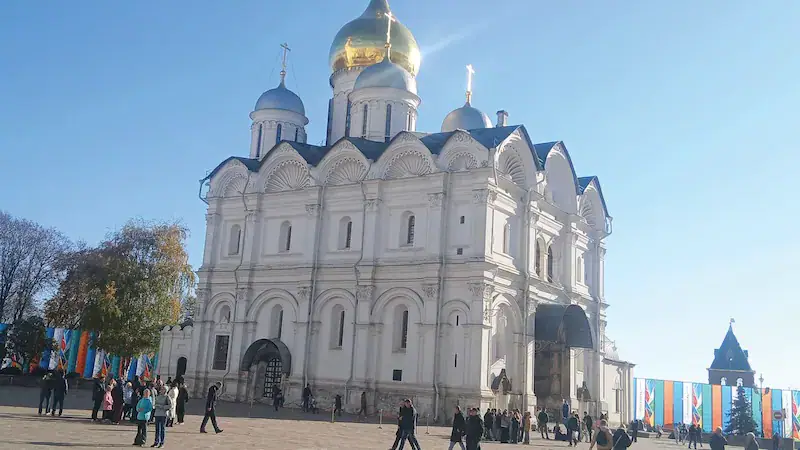
Cathedral Square, located within the Kremlin, is surrounded by prominent cathedrals, including the Cathedral of the Dormition, the Cathedral of the Archangel and the Cathedral of the Annunciation. These cathedrals demonstrate the historical relationship between the Russian state, the monarchy and the Orthodox Church. The Assumption Cathedral served as the principal church for the coronation of Russian rulers, while the Archangel Cathedral became the burial place of several tsars and grand princes. The Annunciation Cathedral was closely associated with the religious life of the royal family.
The Kremlin complex also houses the Arsenal building, which displays thousands of captured cannons and other military trophies. Many of the cannons are associated with Russia's military campaigns, including the defeat and retreat of Napoleon Bonaparte's forces during the 1812 invasion. The collection includes weapons originating from France, Italy and other European countries. Additionally, the Tsar Bell and the Tsar Cannon, located near Cathedral Square, offer a reminder of Russia's military history and the importance the country attaches to preserving its past.
The metro railway system in Moscow provides an efficient and convenient way for residents to travel across the city. The system connects different parts of the city, with automated announcements informing passengers of approaching stations. In contrast to Kampala's public transport system, Moscow's metro operates on a fixed route, eliminating the need for passengers to negotiate with drivers or conductors. The experience revealed a different side of urban life, with most passengers remaining quiet and concentrating on their mobile phones or personal activities.
For a visitor accustomed to Kampala's public transport system, the difference was striking. The metro's efficiency and frequency were notable, with trains arriving regularly and carrying passengers deep below street level on long escalators. The language barrier presented a challenge for some visitors, but the kindness of strangers and the use of technology, such as ChatGPT, helped to overcome these obstacles. A young woman's assistance in guiding two journalists to the correct metro entrance and line exemplified the impact of simple acts of kindness on visitors navigating an unfamiliar city.
The experience in Moscow provided a unique opportunity for African journalists to explore Russia's history, culture and technological advancements. The city's landmarks, cultural heritage and daily life offered a glimpse into a country with a rich and complex history. The journalists' experience in Moscow showcased the importance of preserving cultural heritage and the role of technology in shaping urban life. The Russia-Africa Summit provided a platform for dialogue and cooperation between Russia and African countries, highlighting the significance of cultural exchange and understanding.
Key points
- The Kremlin complex in Moscow serves as a symbol of Russian power and identity, preserving centuries of political, religious and cultural history.
- Moscow's metro system provides an efficient and convenient way for residents to travel across the city, with automated announcements and fixed routes.
- The experience in Moscow highlighted the importance of preserving cultural heritage and the role of technology in shaping urban life.
Reporting sources
- Moscow, from the Russia-Africa Summit sidelines · The Observer