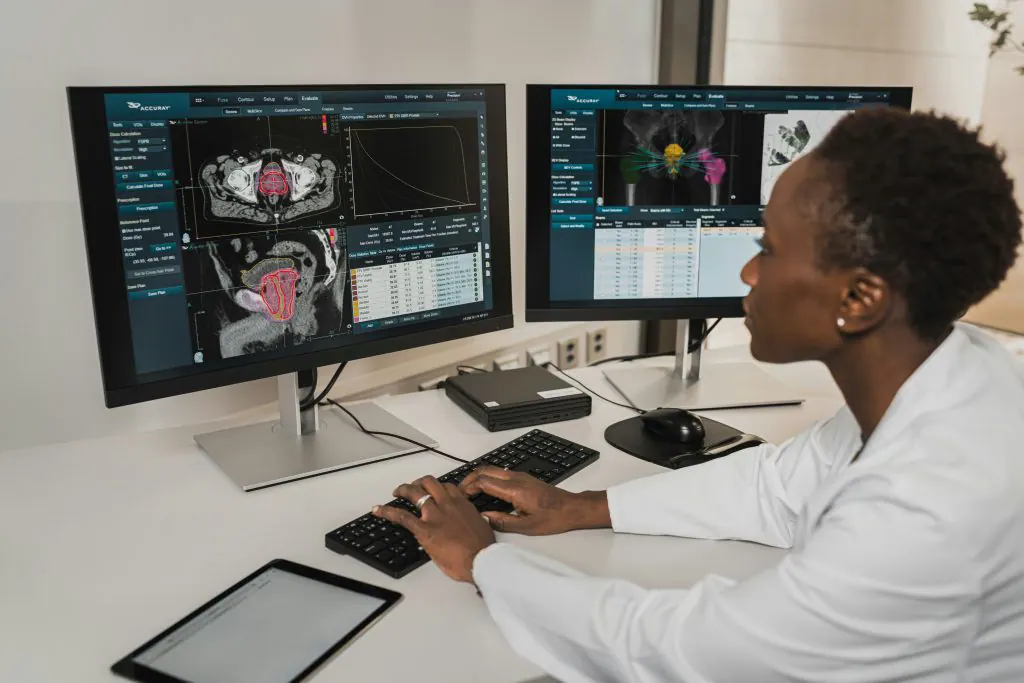
Artificial intelligence (AI) is revolutionizing medical diagnostics in Africa, enabling quality healthcare to reach beyond major hospitals and specialist centres. Start-ups across the continent are developing innovative tools that leverage AI to improve patient outcomes. These tools can analyse medical images, assist with clinical documentation, and help healthcare workers identify conditions in areas where specialists are scarce. This development represents a promising step towards expanding access to quality healthcare. However, it is crucial to distinguish between promise and proven impact.
The World Health Organisation (WHO) projects a global shortfall of 11 million health workers by 2030. In radiology, sub-Saharan Africa has between zero and three radiologists per million people, compared with more than 100 per million in high-income settings. Ghana, for instance, has only 93 certified radiologists serving a population of 32 million, equivalent to approximately one radiologist for every 344,000 people. These shortages define the context in which AI-powered diagnostic tools must operate. The use of AI can help bridge this gap by supporting clinicians and extending diagnostic capabilities.
Several companies across Africa are exploring different applications of medical AI. Ghana-based MinoHealth AI Labs develops the Moremi suite for medical imaging and clinical decision support, with deployments in over 50 countries. South Africa’s Nexus Intelligence offers chest X-ray analysis software that processes images in under 45 seconds. Envisionit Deep AI develops RADIFY for occupational health screening, while Morocco’s DeepEcho focuses on AI-assisted ultrasound and maternal healthcare. These innovations address distinct clinical needs and have the potential to improve patient outcomes.
AI-powered diagnostic tools can analyse images within seconds and flag findings that require attention, potentially helping clinicians prioritise urgent cases. However, a rapid software output does not mean a patient receives a diagnosis within seconds. The complete diagnostic pathway still involves image quality, clinical assessment, confirmation, communication, and access to treatment. The safest approach is to use AI as a decision-support tool, with clinicians interpreting its results alongside symptoms, medical history, and physical examinations.
Clinical studies demonstrate the potential of AI when properly validated. A multicentre study led by Peking Union Medical College Hospital evaluated an AI model for pulmonary nodule classification, achieving an area under the curve (AUC) of 0.939 in internal testing and 0.943 in external validation. In a clinical trial involving 400 patients, junior radiologists’ average AUC increased from 0.667 without AI to 0.776 with AI assistance. These findings illustrate how AI can support clinical decision-making.
For AI tools to be reliable, their development and testing data must reflect the patients, devices, and conditions in which they will be used. Differences in disease prevalence, age, imaging equipment, clinical practices, and image quality can affect performance. African populations also remain underrepresented in global genomic and molecular datasets. Local validation must therefore assess accuracy, sensitivity, specificity, failure rates, and performance across relevant patient groups.
The adoption of AI-powered diagnostic tools also requires appropriate regulatory oversight, infrastructure, and trust among healthcare professionals. National medical-device regulations differ across African countries, complicating cross-border deployment. The African Medicines Agency is advancing regulatory harmonisation, while the African Union’s Model Law provides a framework for aligning regulatory processes. Clinicians highlighted transparency, local validation, and clear accountability as essential to building trust in AI-powered diagnostic tools.
Key points
- Medical AI start-ups are emerging across Africa to address the shortage of healthcare professionals and improve patient outcomes.
- AI-powered diagnostic tools require proper validation, local validation, and regulatory oversight to ensure reliability and trust among healthcare professionals.
- The adoption of AI-powered diagnostic tools also requires infrastructure, including compatible imaging equipment, reliable electricity, staff training, and technical support.