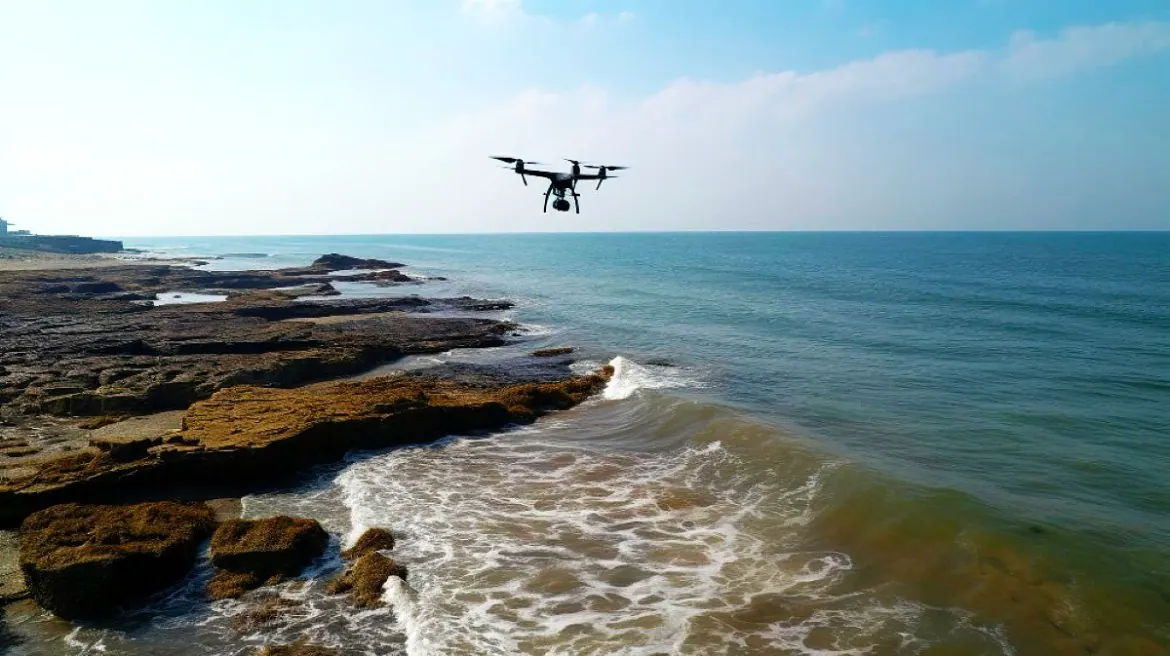
A research associate at the University of Pretoria's Ocean Regions Programme, Tshegofatso Ramachela, has emphasized the need for Africa to deploy unmanned systems to improve its offshore security. Speaking at the Africa Aerospace and Defense (AAD) conference, Ramachela highlighted that drones offer a low-risk, high-reward solution with significantly lower costs compared to traditional maritime vessels. This is particularly crucial for many African coastal and island nations with limited offshore patrol capabilities and insufficient air assets.
Ramachela noted that drones can serve as force multipliers, but they cannot fully supplement traditional maritime forces. However, they can be effectively used for surveillance in vast areas of water, especially in dangerous conditions, while ensuring the personal safety of maritime security officers. Despite the benefits, the continent faces several challenges in deploying and integrating drones into its defense capabilities, including technological and financial constraints, technical limitations, and gaps in legislation and regulations.
The main suppliers of drones to Africa are currently the United States, the United Kingdom, the United Arab Emirates, Israel, and Turkiye. However, there are also several African-based companies manufacturing drones for maritime purposes, such as South Africa's Milkor and Denel, and a Moroccan tech start-up. This year, South Africa's first locally designed and built unmanned surface vessel completed sea acceptance trials and made its international debut.
In Africa, drones have primarily been used to collect data and combat maritime crimes such as piracy, maritime terrorism, and pollution monitoring. Countries like Nigeria, Côte d'Ivoire, Ghana, Angola, and Seychelles are among those using unmanned systems at sea. Seychelles is a frontrunner in utilizing this technology, operating long-range surveillance drones equipped with artificial intelligence to monitor its vast maritime area and combat illegal fishing.
As Africa's maritime security becomes increasingly militarized, there is a concern that the continent may become a testing ground for new prototypes, including the incorporation of artificial intelligence. Ramachela noted that as African countries attempt to enhance their defense capabilities, the demand for drones with maritime applications is expected to rise significantly. This has made Africa a highly profitable market attracting partnerships and investments from various stakeholders.
Ramachela envisioned a future where Africa's vast territorial waters are patrolled and monitored by unmanned and semi-autonomous systems, covering an estimated 30-million square kilometers. However, for now, Africa is considered a consumer rather than a producer of drones. The continent's progress in this area will likely depend on addressing the existing challenges and leveraging partnerships and investments to enhance its maritime security capabilities.
The use of drones in Africa's maritime security is expected to continue growing, driven by the need for effective and cost-efficient solutions. As the continent explores the potential of unmanned systems, it will be crucial to balance the benefits with the challenges and ensure that the deployment of drones is aligned with its defense capabilities and doctrine. The Africa Aerospace and Defense (AAD) conference provided a platform for experts to discuss these issues and explore opportunities for collaboration and innovation.
Key points
- Africa needs to deploy unmanned aircraft to protect its marine precincts and enhance offshore security.
- The continent faces challenges in deploying and integrating drones into its defense capabilities, including technological and financial constraints.
- Africa is considered a consumer rather than a producer of drones, with the main suppliers being the US, UK, UAE, Israel, and Turkiye.