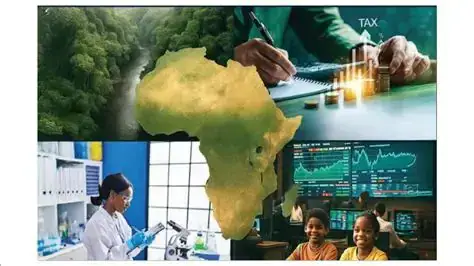
The ongoing competition between major powers like China, the United States, Europe, Japan, and India for energy and critical raw materials has opened up new opportunities for Africa to strengthen its international standing. This dynamic allows Africa to negotiate more favorable terms, leveraging its immense mineral reserves, untapped agricultural potential, and demographic dynamics. With 72% of the world's cobalt and 71% of platinum-group metals, Africa holds significant advantages in the global market.
Africa's mineral wealth is substantial, with 70% of global phosphate reserves, 44% of world chromite production, 36% of manganese, and 21% of gold. The continent is also a major supplier of bauxite, with Guinea providing over 25% of global exports. According to a United Nations University Institute report, Africa holds around 30% of the world's critical mineral reserves, which could generate $16 trillion in revenues by 2050. China's quasi-monopoly over refining these minerals gives African governments bargaining power.
To capitalize on this opportunity, Africa must ensure that public investment in critical minerals translates into local processing capacity and quality jobs. In 2025, public investment in advanced economies reached $65 billion, four times more than in 2023. The Dangote refinery in Nigeria and a planned refinery in East Africa are promising signs for value creation and development of value chains in the region.
Food production is another area where Africa has significant potential. Despite being associated with hunger, some regions have considerable potential for agricultural development. The Democratic Republic of Congo, for example, has over 80 million hectares of arable land, of which less than 10% is farmed. If fully developed, Congolese agriculture could feed over a billion people. Brazil's transformation of the Cerrado region through biotechnology and soil improvement serves as a model for Africa.
Africa's energy potential is well-known, with Nigeria, Gabon, Algeria, and Libya among the main gas and oil producers. New exploration activity and technological advances are expanding energy production to other countries. The Greater Tortue Ahmeyim project on the Senegal-Mauritania border and Mozambique's LNG megaproject are signs that Africa is positioning itself as an alternative energy supplier for Europe and Asia.
Alongside the geopolitical dividend, Africa has a demographic dividend, with a population of 1.55 billion in 2025 expected to reach 2.586 billion by 2050. The continent's median age is just 19, compared with 46 in Europe. By 2040, Africa's working-age population will exceed those of India and China combined. Sub-Saharan Africa grew by 4.5% in 2025, with 31 countries experiencing growth of 4% or higher in 2026.
As Africa seeks to harness its geopolitical dividend, it must navigate the risks associated with global power rivalries. The continent's development will depend on its ability to negotiate favorable terms, create local value chains, and capitalize on its demographic dividend. With careful planning and strategic investment, Africa can transform its future and become a major player in the global economy.
Key points
- Africa holds 30% of the world's critical mineral reserves, which could generate $16 trillion in revenues by 2050.
Reporting sources
- Africa and the opportunity to harness its “geopolitical dividend” · The Tanzania Times – News from Tanzania, Africa, World, Breaking News, Weather, Environment and Climate Change