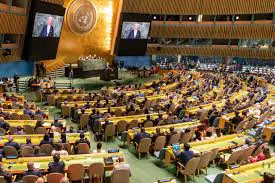
The United Nations Security Council's current structure reflects the geopolitical landscape of 1945, with five permanent members - China, France, Russia, the United Kingdom, and the United States - holding veto powers. Despite comprising 54 UN member states and a significant proportion of the world's population, Africa remains without permanent representation on the Council. This has sparked a legitimate question of historical justice and equitable global representation.
Africa's demand for reform is grounded in its under-representation, which dates back to the creation of the United Nations when most African countries were under colonial rule. The continent has consistently sought reform through various declarations, including the 1997 Harare Declaration, the 2005 Ezulwini Consensus, and the Sirte Declaration. The Common African Position demands at least two permanent seats and five non-permanent seats for Africa on an expanded Security Council.
Africa supports the eventual abolition of the veto, but for now, it seeks the same privileges as existing permanent members. The UN's 2024 Pact for the Future acknowledges the need to address Africa's historical injustice as a priority in Security Council reform. However, achieving permanent representation is challenging, requiring a two-thirds majority of UN members and ratification by all five existing permanent members.
To achieve its goal, Africa must pursue two complementary objectives: continuing its diplomatic campaign for equitable representation and building its economic, technological, scientific, and institutional power. Africa's claim for permanent membership should not be based on matching the industrial or technological achievements of the P5. Instead, the continent must focus on transforming itself through industrialization, scientific achievement, and institutional development.
Africa possesses considerable comparative advantages, including a youthful population, vast agricultural potential, and substantial reserves of critical minerals. However, the continent continues to export its mineral and agricultural wealth in relatively unprocessed forms, importing higher-value manufactured products. This economic model must change, with Africa developing the capacity to process, refine, manufacture, and commercialize finished products within the continent.
The emerging Artificial Intelligence revolution presents another historic opportunity for Africa. To avoid repeating past experiences, the continent must invest in electricity, education, research institutions, digital infrastructure, computing capacity, engineering, and scientific development. African unity will also be critical, with the African Union retaining central responsibility for determining Africa's representation and preventing competition among major African states from undermining the Common African Position.
Securing permanent Security Council seats is not the final measure of Africa's advancement. Africa should pursue representation and transformation simultaneously, building an Africa whose demographic, economic, scientific, technological, and geopolitical importance makes its meaningful participation in global decision-making increasingly indispensable. The strategic objective is to make Africa's global influence impossible to ignore, rather than relying solely on a veto.
Key points
- Africa demands at least two permanent seats and five non-permanent seats on an expanded Security Council.
- The continent's claim for permanent membership is based on historical justice and equitable representation.
- Africa must pursue diplomatic campaigns and build its economic, technological, and institutional power to achieve its goals.