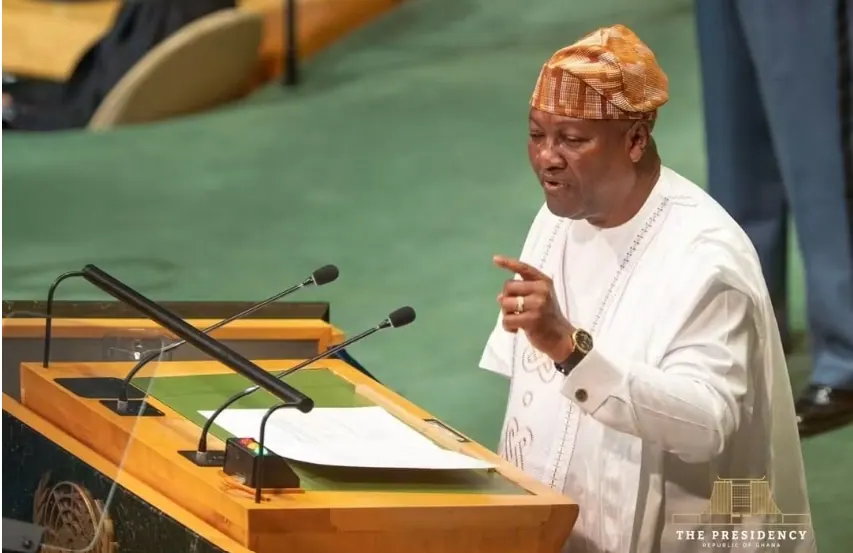
Former Ghanaian President John Dramani Mahama recently spoke at the Council on Foreign Relations in New York, highlighting a critical issue facing Africa: the continent's high borrowing costs. Mahama noted that Africa borrows at eight times the interest rate of the rest of the world, despite being rich in natural resources such as oil, lithium, and cobalt. This has significant implications for the continent's economic development.
Africa's debt problem is complex and multifaceted. According to Mahama, illicit financial flows, debt servicing, and risk premiums all contribute to the continent's debt burden. It is estimated that around $90 billion leaves Africa through illicit financial flows alone, while billions more are lost through interest payments and risk premiums. This has a profound impact on Africa's ability to develop its economies.
The issue of borrowing costs is particularly relevant for Ghana, which is rich in natural resources such as gold, cocoa, and oil. Despite this, the country still struggles with its economy, often relying on the International Monetary Fund (IMF) for support. The IMF has helped Ghana stabilize its economy, but Mahama argues that this does not address the underlying issues driving the country's economic vulnerability.
One of the key challenges facing Ghana is its dependence on the US dollar. Despite being a significant producer of gold and other commodities, the country's economy remains heavily reliant on the dollar. This makes it vulnerable to fluctuations in the foreign exchange market, which can have far-reaching consequences for businesses and individuals.
Recent data suggests that Ghana's international reserves reached $11.9 billion by the end of 2025, thanks in part to strong gold exports. However, this highlights the need for Ghana to think more strategically about its economy. Rather than simply focusing on stabilizing the cedi, the country should be exploring ways to retain more of the value created by its natural resources.
The cocoa industry is a prime example of this challenge. While Ghana is one of the world's largest producers of cocoa, it does not process or manufacture much of the crop itself. This means that the country misses out on significant value-added opportunities, which could help to boost its economy. Mahama has announced plans to increase local cocoa processing to 50%, which could be an important step towards addressing this issue.
Ultimately, Ghana and other African countries need to think differently about their economies and their relationship with international institutions like the IMF. Rather than simply relying on IMF support to stabilize their economies, countries should be exploring ways to build greater economic resilience and independence. This will require a range of reforms, from increasing local processing and manufacturing to promoting diversification and reducing dependence on expensive foreign borrowing.
Key points
- African countries face high borrowing costs despite being rich in natural resources.
- Ghana's economy is heavily reliant on the US dollar, making it vulnerable to fluctuations in the foreign exchange market.
- The country needs to think strategically about retaining more of the value created by its natural resources, such as cocoa and gold.