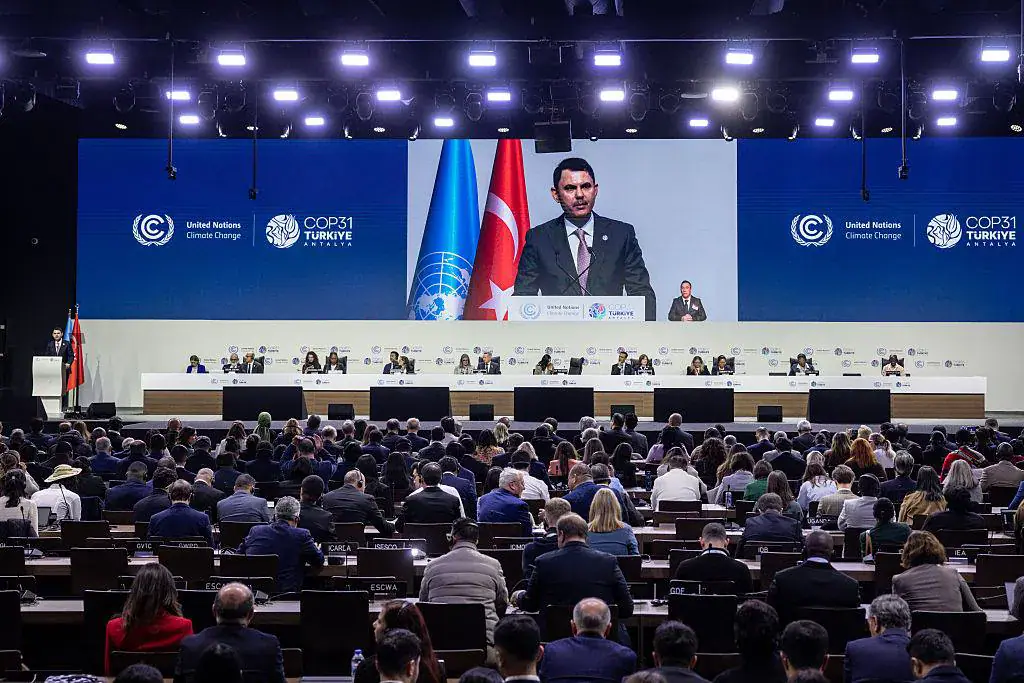
African countries are facing renewed uncertainty over climate financing after the collapse of CoP31 negotiations in Antalya, Türkiye. The negotiations ended in disarray, with governments unable to agree on a final cover decision addressing climate finance, the phase-out of fossil fuels, and a just transition. This has raised fresh concerns about developing countries' ability to respond to escalating climate threats.
The collapse of the negotiations has significant implications for African countries, which had been seeking concrete delivery on climate commitments. Ghana's Minister of Environment, Science and Technology, Zanetor Agyeman-Rawlings, speaking on behalf of the African Group of Negotiators on Climate Change, criticised the outcome. She stated that commitments on adaptation finance lacked clear targets and implementation mechanisms.
Agyeman-Rawlings expressed disappointment that the final text reaffirmed the goal of at least tripling adaptation finance by 2035 but failed to establish a baseline or specify the amount required. She also noted that the text merely welcomed and encouraged support for loss and damage without setting concrete funding targets. Furthermore, provisions on a just transition lacked substance to reflect Africa's development realities.
Malawi, a country heavily impacted by climate change, faces significant challenges in financing its climate commitments. The government estimates that implementing its climate commitments will require $7.06 billion between 2025 and 2035. Approximately $4.28 billion is expected from international climate finance, representing about 61 percent of the total. The remaining $2.78 billion is expected to come from domestic and other unconditional resources.
Malawi's climate financing gap is substantial, with the country's National Adaptation Plan financing strategy estimating annual adaptation needs at approximately $916 million. However, existing financing is only about $203 million, leaving an annual shortfall of roughly $700 million. The country's reliance on debt-based financing for climate-related investments is also a concern, with 61 percent of public climate financing in the national budget coming from blended financing, comprising loans and grants.
The failure to reach an agreement on climate finance at CoP31 has stalled the operationalisation of the Belém-Antalya Mechanism, a proposed framework for advancing international cooperation on a just transition away from fossil fuels. Developed countries, particularly members of the European Union (EU), were accused of blocking progress. The deadlock comes as many low- and middle-income countries spend significant public resources on debt repayments and interest, leaving limited fiscal space for climate adaptation and renewable energy investments.
Environmental campaigners have criticised the outcome of CoP31, arguing that it failed to confront the main causes of the climate crisis. The emphasis on carbon capture and storage has also been criticised, as it could prolong dependence on fossil fuels rather than address their extraction and production. The failure of CoP31 to deliver on climate finance has significant implications for vulnerable countries, which must now wait for further discussions on a framework intended to support workers, communities, and economies affected by the transition.
Key points
- African countries face a significant climate financing gap, with Malawi estimating a requirement of $7.06 billion between 2025 and 2035.
- The collapse of CoP31 negotiations has stalled the operationalisation of the Belém-Antalya Mechanism, a proposed framework for advancing international cooperation on a just transition away from fossil fuels.
- Environmental campaigners have criticised the outcome of CoP31, arguing that it failed to confront the main causes of the climate crisis.
Reporting sources
- Africa’s climate finance hopes dashed as CoP31 negotiations collapse · The Daily Times