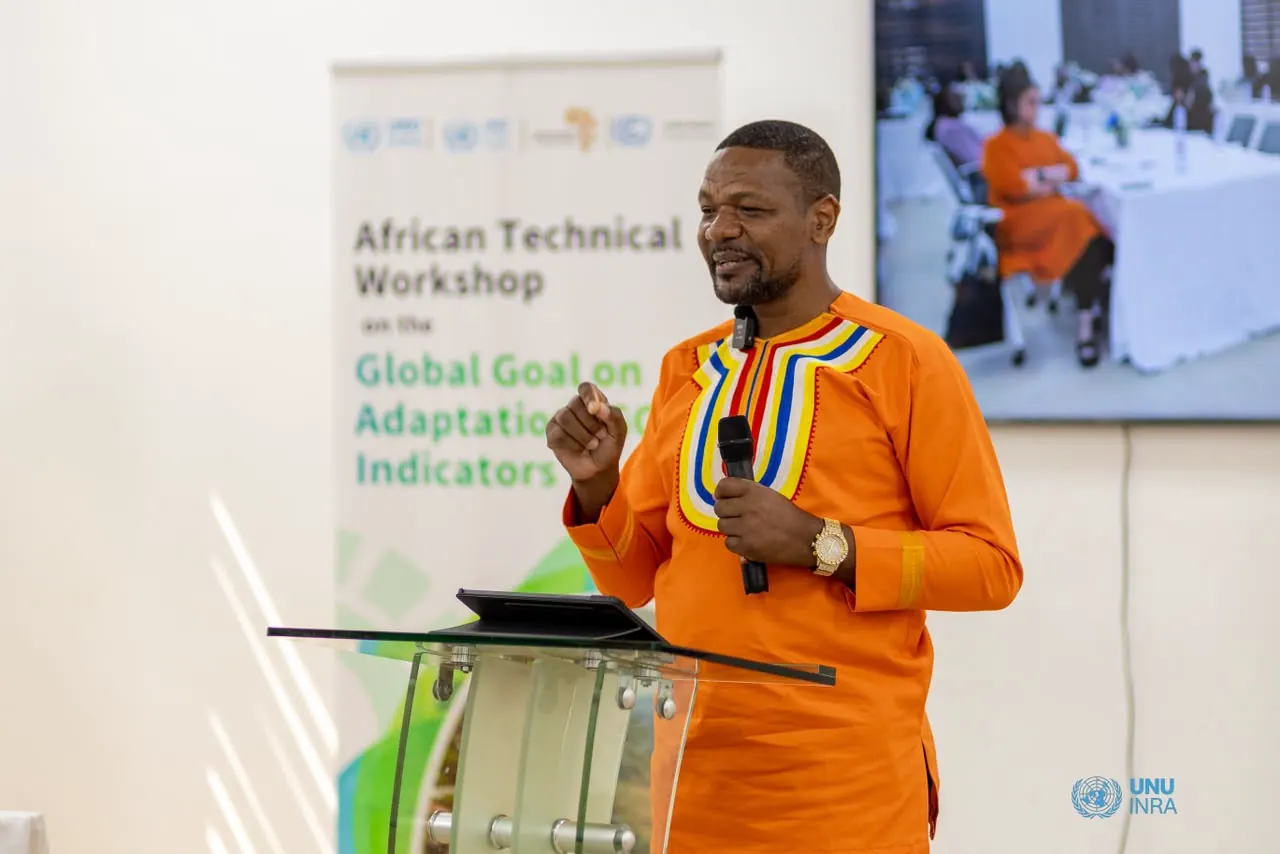
Dr Richard Munang, Director of the United Nations University-Institute for Natural Resources in Africa (UNU-INRA), has emphasized that fighting climate change in Africa should focus on how climate change adaptation has worked for people and improved their economic status. He made these remarks at the African Technical Workshop on the Global Goal on Adaptation (GGA) Indicators in Accra, which aimed to serve as a training platform ahead of COP31. The workshop was a collaboration between UNU-INRA, UNU Global Health, the African Group of Negotiators, and UNFCCC.
The GGA workshop provided a practical, country-led platform for translating GGA indicators into national implementation, with Ghana serving as the pilot country. Participants assessed how national adaptation ambitions reflected in the National Adaptation Plan (NAP) and relevant datasets aligned with the GGA targets and indicators. The exercise identified areas where indicators are relevant and measurable, where data and institutional gaps remain, and where important national adaptation outcomes may not be fully captured.
Dr Munang highlighted that developing countries received $26 billion of international money for adaptation but would need $310 billion or more by 2035. He stressed that when this money comes, it must protect people from climate challenges. He proposed five key areas of focus, emphasizing that adaptation is a changing process with no definitive end point. Without protecting people, societies may not be able to adapt to the changing climate.
Dr Munang noted that when adaptation fails, the financial, operational, and human burdens fall directly on hospitals and healthcare systems. Instead of preventing disasters through early warning networks, infrastructure upgrades, and climate-resilient planning, societies are forced to pay a much heavier price in treating the physical consequences. This highlights the importance of effective adaptation measures.
The UNU-INRA director announced plans to publish a report on the various promises made by rich countries to triple resources for adaptation to 2025, starting at the Belem conference, and the Glasgow Climate Pact promise, which failed to double adaptation finance to $40 billion per year by 2025. This report aims to hold countries accountable for their commitments.
Dr Munang emphasized that climate change adaptation protects and increases personal income, offering economic returns that can put money back into people's pockets. Investing in climate resilience generates dividends, rather than being a pure expense. This perspective underscores the importance of prioritizing adaptation efforts that benefit people directly.
The Ghana pilot project will provide practical lessons for officials from other African countries, helping to inform how the GGA indicators can be applied in different national contexts and support wider African engagement on GGA implementation in the lead-up to COP32. The workshop has equipped participants with the knowledge and skills to implement effective adaptation measures that benefit people and improve their economic status.
Key points
- Dr Richard Munang emphasizes the need for climate change adaptation in Africa to focus on improving people's economic status.
- The GGA workshop in Accra aimed to translate GGA indicators into national implementation, with Ghana as the pilot country.
- Dr Munang highlighted the significant funding gap for adaptation efforts in developing countries, with a need for $310 billion or more by 2035.