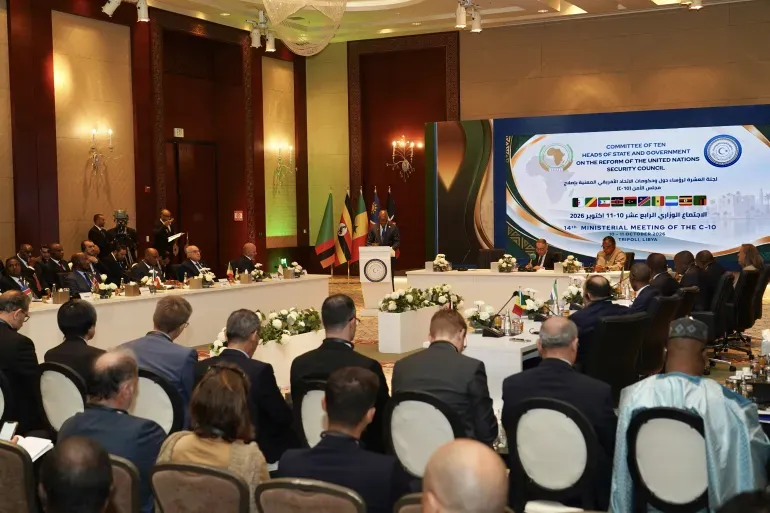
African countries are calling for a more equitable representation on the United Nations Security Council. The issue was discussed at a recent meeting of the African Union's Committee of Ten on UN Security Council reform, held in Tripoli, Libya. The committee, which represents the continent's interests, emphasized the need to address the "historical injustice" faced by Africa.
The Libyan Foreign Ministry stated that the meeting's outcome included a commitment to enhance coordination among member states and intensify diplomatic efforts to garner international support for Africa's position. The ministry's statement highlighted the importance of promoting a unified African voice on the issue. This push for reform is part of a broader effort to ensure that the UN Security Council better reflects the diversity of its member states.
Africa currently holds three non-permanent seats on the UN Security Council, occupied by Liberia, the Democratic Republic of Congo, and Somalia. However, African nations are seeking a more substantial presence, with a demand for two permanent seats and five non-permanent seats. This would enable the continent to have a greater say in global decision-making and address issues that affect its populations.
The Committee of Ten, established in 2005 under the African Union, comprises representatives from Algeria, the Congo, Equatorial Guinea, Guinea, Kenya, Libya, Namibia, Senegal, Sierra Leone, Uganda, and Zambia. The committee's primary goal is to promote a unified African position on UN Security Council reform. Its members are tasked with advancing the continent's interests and negotiating with other UN member states.
The outcome of the Tripoli meeting was encapsulated in the "Tripoli Document 2026," which outlines proposals for advancing Africa's position on UN Security Council reform. The document emphasizes the need for enhanced follow-up mechanisms and intensified communication with influential countries. These efforts aim to drive progress on reform and achieve the continent's aspirations for greater representation.
African leaders argue that the current composition of the UN Security Council does not accurately reflect the continent's significance or its contributions to global affairs. They contend that a more representative council would be better equipped to address pressing global challenges, including peace and security issues. The African Union has consistently emphasized the importance of reforming the UN Security Council to make it more inclusive and representative.
The push for UN Security Council reform is part of a broader effort to strengthen Africa's voice in global governance. African nations are seeking to assert their influence on key international issues, including peace and security, sustainable development, and human rights. The outcome of the Committee of Ten's efforts will likely have significant implications for Africa's role in global affairs and its ability to shape international policy agendas.
Key points
- African nations demand two permanent and five non-permanent seats on the UN Security Council.