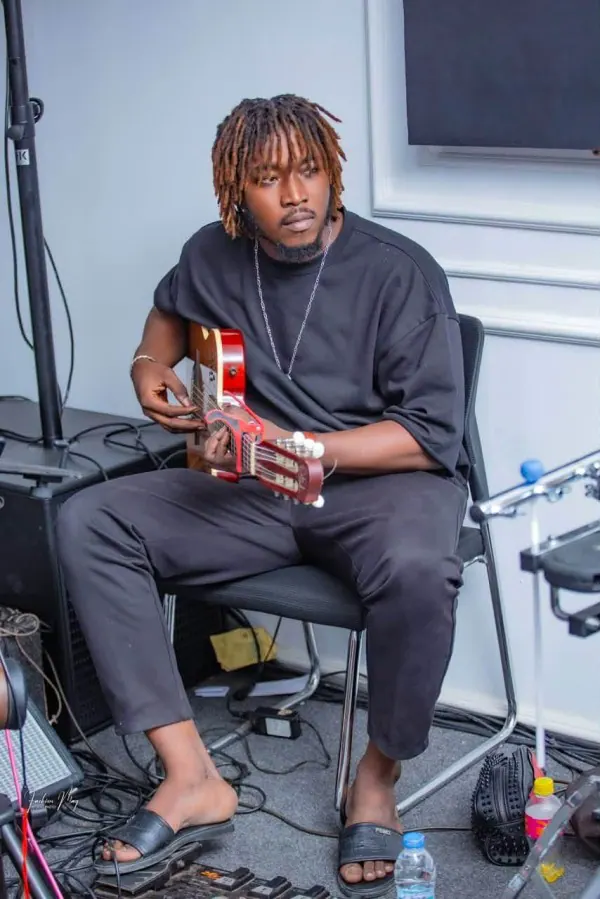
Adama Diabaté, affectionately known as "Dada," is a visionary artist from Abobo, Abidjan, Côte d'Ivoire. Born into a lineage of Dafing griots, his father, Amadou Diabaté, was a renowned guitarist and a prominent figure in Ivoirian griot circles. Diabaté's mother, a griotte, passed down authentic vocal traditions to him. With a musical upbringing, Diabaté began his career under the mentorship of his uncle, Madou Koussoumbou.
Diabaté's musical journey took a significant turn in 2014 when he returned to Mali to explore new sounds and join the vibrant Malian music scene. He started as a guitarist with formations like Seven Star and later joined the Soul Train Band, a popular Bamako club circuit orchestra. As an integral part of the band, Diabaté accompanied numerous local artists on stage and in the studio, honing his skills and gaining recognition.
Diabaté's talent soon led to him arranging songs for various artists, earning him a reputation in Mali's music industry. His notable works include arrangements for Sidiki Diabaté's "Diarabi Nèné Bena" and Mohamed Diaby's "Kissai." He has also collaborated with Malian star Mariam Ba, showcasing his ability to enhance musicians' voices. These compositions demonstrate Diabaté's skill in blending traditional and modern sounds.
As a creative force behind his wife Fatim Diabaté's music, Diabaté takes on the roles of author, composer, and arranger. Her hit song "La Diaba (Ladiayaba)" is one of his notable works. Diabaté's mastery of traditional Mandingue guitar has allowed him to seamlessly incorporate various rhythms and styles, from Zouglou to War music and urban pop.
Diabaté's reputation extends beyond Mali and Côte d'Ivoire, with collaborations in Guinea and other West African countries. He has worked with prominent artists like Azaya and Djely Kaba Bintou, as well as hip-hop and urban music figures like Lil Dou, Master Soumy, and Dr. Keb. This blend of traditional and modern styles has made Diabaté a sought-after producer and arranger.
With his unique sound, Diabaté has become an essential figure in West African music. His ability to merge modern studio standards with traditional melodies has earned him recognition across borders. As a visionary artist, Diabaté continues to push the boundaries of Mandingue music and urban sounds.
Today, Adama Diabaté's influence spans multiple genres and countries, solidifying his position as a leading musician in West Africa. His collaborations and works demonstrate his innovative approach to music, bridging tradition and modernity.
Key points
- Adama Diabaté's music combines traditional Mandingue sounds with urban styles.
- He has collaborated with prominent West African artists across multiple genres.
- Diabaté's work has earned him recognition beyond Mali and Côte d'Ivoire.