Former President of Ghana, John Dramani Mahama, has emphasized the need for the Accra Reset initiative to transition from conceptual discussions to tangible results. Speaking at a high-level event on the sidelines of the 81st United Nations General Assembly in New York, Mahama warned against the initiative becoming another international project with lofty declarations but little impact on citizens.
The Accra Reset initiative has now progressed beyond its design phase, with Ghana and the Presidential Council set to collaborate with governments, global health organizations, development finance institutions, philanthropies, and private-sector actors. This next phase aims to translate the initiative's recommendations into practical country-level agreements. Mahama's comments highlight the urgency of turning plans into action.
A key aspect of the Accra Reset's execution phase will be building networks that link research, regulatory oversight, local manufacturing, and reliable distribution. Potential partners for this endeavor include institutions in Africa, Asia, India, Indonesia, and the Gulf. By forging these connections, the initiative seeks to strengthen domestic capabilities while promoting international cooperation.
Mahama stressed that the Accra Reset is not about promoting isolationism but rather "pragmatic interdependence." This approach encourages countries to work together as equals while developing stronger domestic capabilities. The initiative's focus on collaboration and mutual benefit is seen as a crucial step towards achieving its goals.
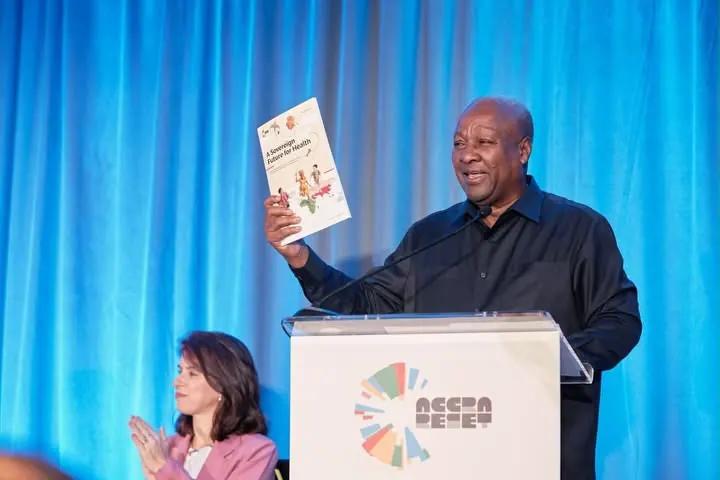
During the event, Mahama formally launched the High-Level Panel's report, A Sovereign Future for Health. The report contains five proposed political shifts and ten recommendations for reforming global health governance. The document provides a roadmap for the Accra Reset's future efforts and outlines its vision for a more equitable and effective global health landscape.
The success of the Accra Reset will be closely watched, particularly in Ghana, where Mahama's administration has prioritized healthcare and economic development. As the initiative moves into its execution phase, stakeholders will be looking for concrete results and tangible progress. Mahama's leadership and commitment to the Accra Reset will be crucial in driving this process forward.
The Accra Reset's focus on local drug production and maternal and child health has been highlighted as a key area of focus. The initiative's progress will be assessed, and commitments renewed, as Mahama takes the Accra Reset agenda into the African Union framework in 2027.
Key points
- The Accra Reset initiative aims to move from design to execution.
- The initiative focuses on building networks that link research, regulatory oversight, local manufacturing, and reliable distribution.
- The Accra Reset promotes "pragmatic interdependence" among countries.