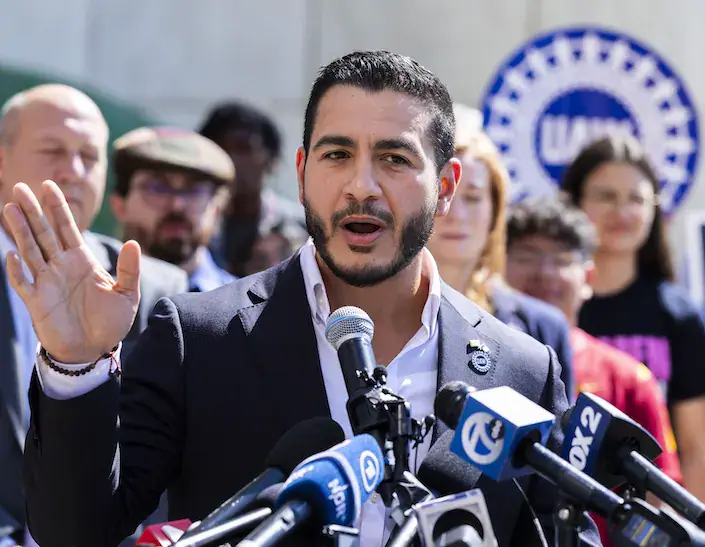
Abdulrahman Mohamed El-Sayed, born on October 31, 1984, in Rochester Hills, Michigan, has made history by becoming the first Muslim to be elected to the US Senate. El-Sayed, an epidemiologist and former director of the Detroit Health Department, won the election in the key state of Michigan. His victory marks a significant milestone in US politics, as he is the first American of Muslim faith to sit in the Senate. El-Sayed's background in public health and his experience as a director of the Detroit Health Department have prepared him for his new role.
El-Sayed's journey to the Senate began with his academic achievements. He graduated from the University of Michigan, where he was also a lacrosse team captain, and later earned a prestigious Rhodes Scholarship to study at Oxford University. At Oxford, he obtained a DPhil in public health, specializing in the social determinants of health inequalities. He then completed his medical degree at Columbia University in New York. This combination of scientific and medical expertise has shaped his vision for healthcare and social justice.
Before entering politics, El-Sayed served as the director of the Detroit Health Department from 2015. At just 30 years old, he was the youngest person to hold this position in a major US city. During his tenure, he faced significant challenges, including the city's bankruptcy and underfunded public services. El-Sayed approached public health through the lens of social justice, addressing systemic issues such as pollution and lead contamination in schools. His efforts focused on promoting health equity and improving healthcare outcomes for marginalized communities.
El-Sayed's entry into electoral politics began with his campaign for the Democratic nomination for governor of Michigan in 2018. Although he lost to Gretchen Whitmer, his campaign raised his profile on the progressive scene. He gained the support of prominent progressive figures, including Bernie Sanders and Alexandria Ocasio-Cortez. El-Sayed's ideology is rooted in economic equity and regulation of monopolies. His campaign priorities for the Senate include implementing a universal healthcare system, regulating tech giants, and prohibiting corporate financing of campaigns.
The 2026 Senate campaign in Michigan was highly contested, with El-Sayed facing opponents within the Democratic Party and in the general election. As an Arab-American Muslim, El-Sayed faced attempts to marginalize him, but he effectively countered by emphasizing his commitment to the US Constitution and the principles of inclusivity and patriotism. His campaign was notable for its grassroots support, with a focus on small individual donations.
El-Sayed's election to the Senate has significant implications for US society. His victory reflects the growing diversity of American politics and the increasing representation of minority groups in government. As the first Muslim Senator, El-Sayed brings a unique perspective to the Senate, shaped by his experiences as a public health expert and his commitment to social justice.
El-Sayed's historic win is expected to inspire greater civic engagement and representation among Muslim Americans and other underrepresented groups. His campaign and election have demonstrated the importance of inclusive politics and the power of progressive ideas. As he takes his seat in the Senate, El-Sayed will play a key role in shaping policy debates and advocating for the rights of marginalized communities.
Key points
- Abdulrahman Mohamed El-Sayed is the first Muslim to be elected to the US Senate, marking a significant milestone in US politics.