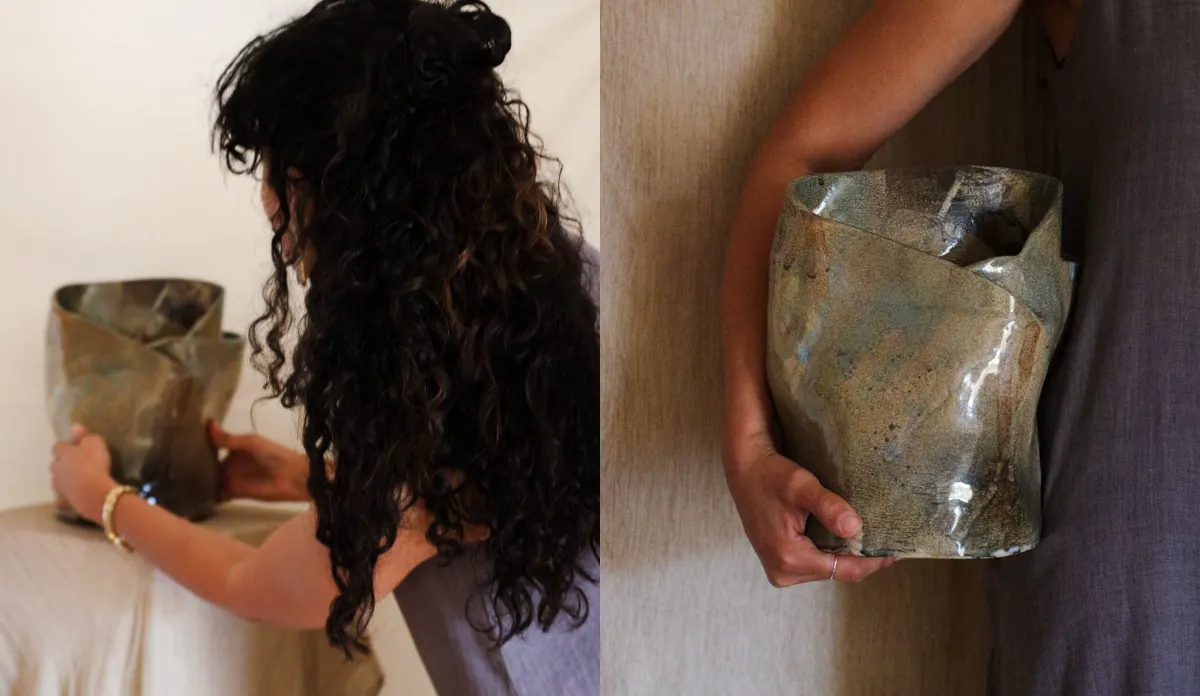
In 2009, the Jameel House of Traditional Arts opened in Cairo, offering a two-year program in traditional arts, including sacred geometry, observational drawing, and decorative patterns. The program, delivered by The King's Foundation School of Traditional Arts in London, aims to preserve traditional crafts such as ceramics, glass, and metalwork. Youmna Hazzaa, a recent student, reflects on her transformative experience at the Jameel House, where she merged her contemporary art background with traditional techniques.
Hazzaa, who had spent a decade in advertising, had become disillusioned with the industry's fast-paced and competitive nature. After moving back to Cairo, she embarked on a period of self-discovery, eventually applying to the Jameel House program. Her application was accepted, and she began her journey in traditional arts, bringing her unique perspective to the program. Hazzaa's experience at the Jameel House has been one of growth and transformation, as she learned to appreciate the value of slowing down and focusing on the creative process.
During her time at the Jameel House, Hazzaa encountered various traditional crafts, including Islamic geometry, ceramics, and gypsum. She was particularly drawn to Islamic geometry, which involves dissecting patterns to understand their underlying philosophy. Instructor Mohamed El Deeb explained that by studying these patterns, students can enter the mind of the original creator, gaining a deeper understanding of the art form. Hazzaa found this approach to be a departure from her advertising background, where the focus was on creating new concepts and ideas.
Hazzaa's transition from advertising to traditional arts was not without its challenges. Initially, she found the process of copying traditional patterns to be uncreative and inauthentic. However, as she continued her studies, she began to appreciate the value of tradition and the importance of preserving cultural heritage. Hazzaa was inspired by the work of textile designer and poet William Morris, who had taken traditional art forms and fused them with his own unique style. She realized that her role was not to modernize tradition, but to allow tradition to modernize her.
As Hazzaa continued her studies, she began to value the process of creating traditional art, rather than just focusing on the end result. She learned to appreciate the imperfections and uniqueness of handmade art, which was a departure from the polished and perfected world of advertising. Hazzaa's experience at the Jameel House has been one of personal growth, as she has learned to slow down and focus on the creative process.
Hazzaa's artistic practice, known as "Little Stories," has evolved significantly during her time at the Jameel House. She has merged her contemporary art background with traditional techniques, creating unique and innovative pieces. Hazzaa's experience at the Jameel House has shown her that tradition is not static, but rather a dynamic and evolving process that can be influenced by individual perspectives.
As Hazzaa looks back on her first year at the Jameel House, she reflects on the transformative power of traditional arts. She has learned to value the process of creating art, rather than just focusing on the end result. Hazzaa's experience serves as a testament to the importance of preserving cultural heritage and the value of merging traditional techniques with contemporary perspectives.
Key points
- Youmna Hazzaa's experience at the Jameel House of Traditional Arts has been one of personal growth and transformation.
- The Jameel House program aims to preserve traditional crafts and cultural heritage.
- Hazzaa's artistic practice, "Little Stories," has evolved significantly during her time at the Jameel House.