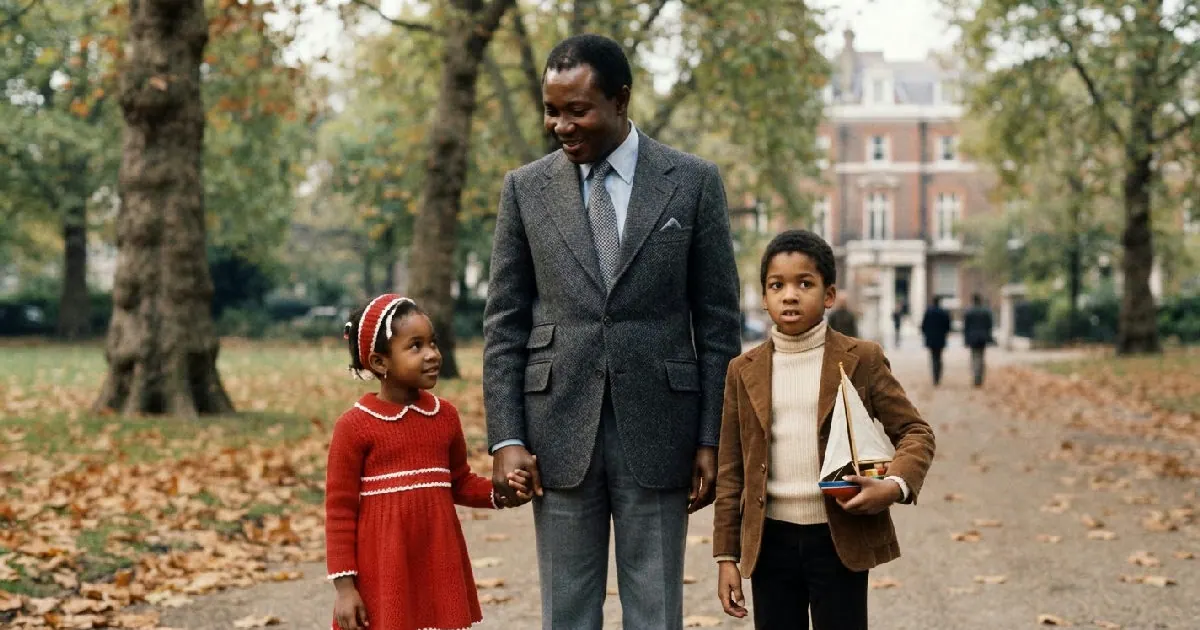
On 25 October 1975, photographer Terence Spencer captured a quiet family portrait of General Yakubu Gowon with his young children, Ibrahim and Saratu, in London. This intimate moment, preserved in the Popperfoto collection, starkly contrasted with the dramatic political upheaval that had engulfed Nigeria just months prior. Gowon had been removed from office in a bloodless military coup on 29 July 1975, while attending the twelfth Organisation of African Unity (OAU) summit in Kampala, Uganda.
Yakubu Gowon had led Nigeria through a tumultuous period, including the Nigerian Civil War from 1967 to 1970. His leadership during this period was pivotal, culminating in the “no victor, no vanquished” policy aimed at national reintegration. After the war’s end in January 1970, Nigeria experienced significant change, fueled by surging oil revenues and growing aspirations for national development. However, Gowon’s military government faced increasing criticism regarding administrative efficiency, corruption, and delays in returning to civilian rule.
The military officers who deposed Gowon chose a strategic moment, with the Head of State outside Nigeria, attending the OAU summit. Colonel Joseph Nanven Garba announced the change over Radio Nigeria, declaring Gowon was no longer Head of State. The coup triggered immediate emergency measures, including a curfew and temporary closure of Nigeria’s borders and airports. Brigadier Murtala Mohammed emerged as the new Head of State and Commander in Chief of the Armed Forces.
The photograph by Terence Spencer offered a strikingly personal view of the former Head of State, showing Gowon alongside his young son, Ibrahim, and daughter, Saratu, in London. Ibrahim, born in 1970, was around five years old, while Saratu, born in 1972, was approximately three. This intimate portrayal lent a human dimension to a figure recently at the centre of national power, revealing a life that extended beyond the political arena.
General Yakubu Gowon arrived at Gatwick Airport on 12 August 1975, from Lomé, and reunited with his family in London. He began a new chapter, enrolling at the University of Warwick, where he embarked on a doctoral program researching regional cooperation in West Africa. His academic journey culminated in a PhD in Political Science, with his thesis submitted in February 1984.
Gowon’s exile in Britain was not entirely free from political turbulence. On 13 February 1976, an attempted coup led to the assassination of Head of State Murtala Mohammed. Gowon was subsequently implicated in allegations connected to this coup attempt, complicating his ongoing absence from Nigeria and prolonging his period of exile. He remained in Britain for several more years, steadfastly pursuing his academic goals.
A significant turning point came in 1983 when Gowon received a pardon under the civilian administration of President Shehu Shagari, allowing him to return to Nigeria. Later, his military rank was officially restored in 1987 during the government of General Ibrahim Babangida, marking a full circle in his public life.
Key points
- The photograph of Yakubu Gowon with his children in London offers a rare glimpse into his personal life after his removal from office.
- Gowon’s leadership during the Nigerian Civil War was pivotal, culminating in the “no victor, no vanquished” policy aimed at national reintegration.
- Gowon pursued a doctoral program at the University of Warwick, researching regional cooperation in West Africa, and submitted his thesis in February 1984.