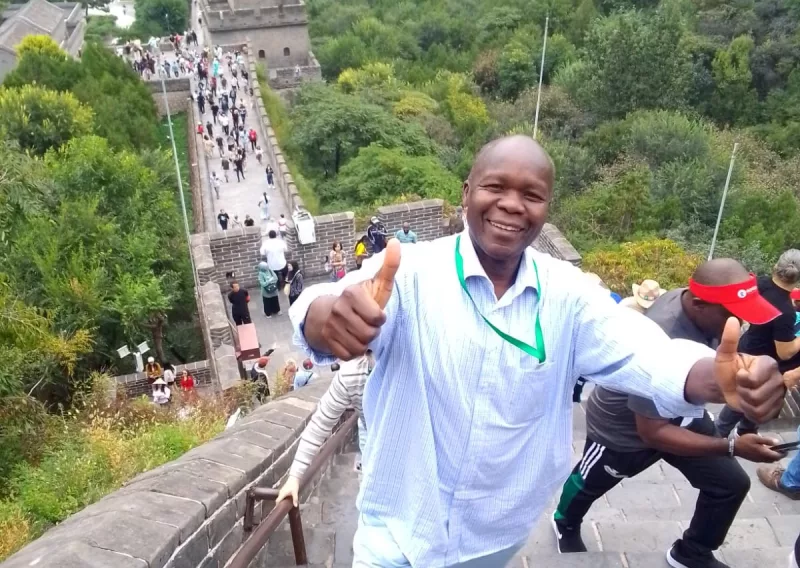
Kenyan journalist Joseph Olweny recently visited Beijing, China, where he was struck by the city's cashless economy. He recounted his experience of getting a haircut at a local spa, where he struggled to communicate with the staff due to a language barrier. Despite the challenges, Olweny was fascinated by the efficiency of the cashless system, which allowed him to make transactions using QR codes.
Olweny's experience at the spa highlighted the differences between Kenya and China when it comes to making transactions. In Kenya, cash is still widely used, whereas in Beijing, cashless transactions are the norm. The journalist was impressed by the convenience of the system, but also encountered some challenges, such as finding change for a 100 Yuan note.
The spa staff were curious about Olweny's kinky hair, and he was touched by their gentleness when washing and cutting his hair. However, when it came to paying for the service, Olweny handed over a 100 Yuan note, which caused a crisis as the staff did not have any change. The staff had to search for change, highlighting the limitations of the cashless system.
Olweny's experience in Beijing was a eye-opener, showcasing the city's ultra-modern and super-efficient infrastructure. He was impressed by the city's underground trains, which arrived on time, and the polite motorists who waited patiently at intersections. However, he also encountered some challenges, such as getting lost in the city and struggling to communicate with the locals.
Despite the challenges, Olweny was fascinated by Beijing's cashless economy, which he described as "M-Pesa in a hurry." He noted that the city's residents use WeChat Pay or Alipay for most transactions, making cash almost obsolete. Olweny's experience highlighted the differences between Kenya and China, and the need for Kenyans to adapt to new technologies.
Olweny's visit to Beijing was a humbling experience, as he encountered many challenges, including getting lost and struggling to communicate. However, he was also impressed by the city's efficiency and modernity, and noted that Beijing is a city of the future. He encouraged Kenyans to learn from China's experience and adapt to new technologies.
In conclusion, Olweny's experience in Beijing highlighted the city's cashless economy and modern infrastructure. He encountered some challenges, but was impressed by the efficiency and convenience of the system. As Kenya looks to the future, Olweny's experience serves as a reminder of the need to adapt to new technologies and innovations.
Key points
- Beijing's cashless economy is a model of efficiency and convenience.
- The city's residents use WeChat Pay or Alipay for most transactions, making cash almost obsolete.
- Kenyans can learn from China's experience and adapt to new technologies.