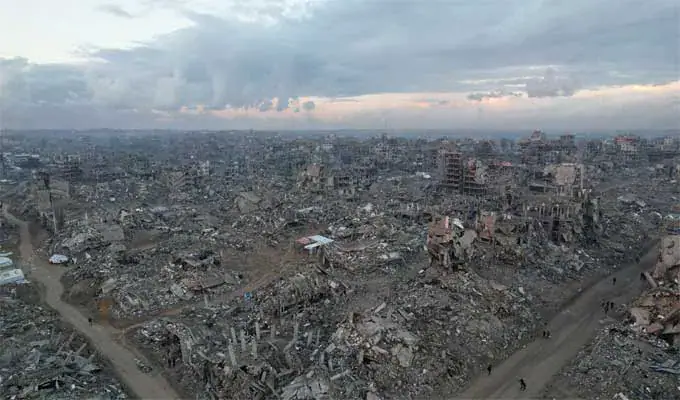
A recent report by Oxfam and the Conflict and Environment Observatory (CEOBS) has revealed that 99% of the Gaza territory has been affected by environmental contamination. The report, titled "Environmental War Crimes: How Military Offensive Turned Gaza into a Toxic Territory Threatening Human Survival," details the devastating consequences of military operations in the Palestinian enclave over the past three years. The use of explosives and incendiary weapons has led to widespread contamination of water, air, and soil.
The report highlights that military operations have affected approximately 78% of the enclave over the past three years. The intense bombardment and use of explosive munitions, destruction of buildings, water infrastructure, sewage plants, industrial and energy facilities, agricultural land, and waste management systems have all contributed to the environmental degradation. These actions have released a complex mixture of pollutants into the environment, posing significant threats to the health and survival of Gaza's 2.3 million inhabitants.
The contamination of water resources, collapse of sanitation systems, and persistent soil pollution are among the primary concerns identified in the report. Residues from explosives, heavy metals, and other toxic substances threaten agricultural land and could compromise food security when agricultural activities resume. The report also warns of the health risks associated with air pollution, including respiratory problems and lung injuries caused by dust from destroyed buildings and burning waste.
The accumulation of potentially hazardous debris is another significant concern. According to the United Nations Environment Programme (UNEP), military operations have generated over 61 million tons of rubble. This widespread contamination directly threatens the health and survival of the Palestinian population, with children, the elderly, chronically ill individuals, and those recovering from injuries being among the most vulnerable.
The report's authors emphasize that the environmental crisis in Gaza is not a secondary issue but an integral part of the humanitarian crisis. Lama Abdul Samad, lead author and researcher, stresses that the environmental and health consequences of the military operations will likely persist long after the immediate destruction, further complicating the restoration of living conditions in the enclave.
The report calls for urgent attention to address the environmental and health impacts of the military operations in Gaza. The authors argue that the international community must take action to prevent further environmental degradation and ensure that the necessary measures are taken to protect the health and well-being of the Palestinian population.
The environmental contamination in Gaza is a pressing concern that requires immediate attention and action. The report's findings highlight the need for a comprehensive approach to address the environmental and health impacts of the military operations and ensure a sustainable and healthy future for the people of Gaza.
Key points
- 99% of Gaza territory affected by environmental contamination
- Military operations have generated over 61 million tons of rubble
- Environmental crisis in Gaza is an integral part of the humanitarian crisis