Product development often involves unexpected twists and turns. Several well-known products were initially designed to solve one problem but ended up becoming household names by addressing a completely different need. This phenomenon highlights the importance of adaptability and innovation in the product development process. Companies have successfully pivoted their products to cater to new markets, resulting in significant commercial success. Examples of such products include Bubble Wrap, Play-Doh, and Post-it Notes. These products demonstrate that failure can sometimes lead to unexpected opportunities.
Bubble Wrap, a ubiquitous packaging material, was initially designed as a textured wallpaper in 1957 by engineers Alfred Fielding and Marc Chavannes. The product failed to gain traction in the home decor market. The inventors then attempted to market it as greenhouse insulation, but this idea also failed. It wasn't until 1960, when the duo founded Sealed Air and realized the air pockets in the material could absorb impacts, that Bubble Wrap found its true purpose. IBM's need for a lightweight, shock-proof way to ship delicate electronics provided the perfect opportunity for Bubble Wrap to prove its value.
Play-Doh, a popular children's toy, was originally designed as a wallpaper cleaner in the 1930s by Kutol Products. The company formulated a soft, non-toxic putty to strip dark coal soot off wallpaper. However, with the shift from coal furnaces to cleaner oil and gas for residential heating after World War II, the demand for wallpaper cleaner decreased significantly. The company's fortunes turned when Kay Zufall, a nursery school teacher, suggested using the putty as an art tool for children. Kutol removed the detergent, added bright dyes and a sweet scent, and rebranded the product as Play-Doh in 1956.
Post-it Notes, another well-known product, were initially designed as an ultra-strong adhesive for aerospace applications by 3M scientist Spencer Silver in 1968. However, his experiments produced tiny, reusable micro-spheres of glue that stuck lightly to surfaces without bonding permanently. It wasn't until 1974, when Art Fry, another 3M scientist, used the adhesive to hold paper bookmarks in place, that the true potential of Post-it Notes was realized. The product was launched in 1977 and became a huge success after a massive promotional giveaway in Boise, Idaho.
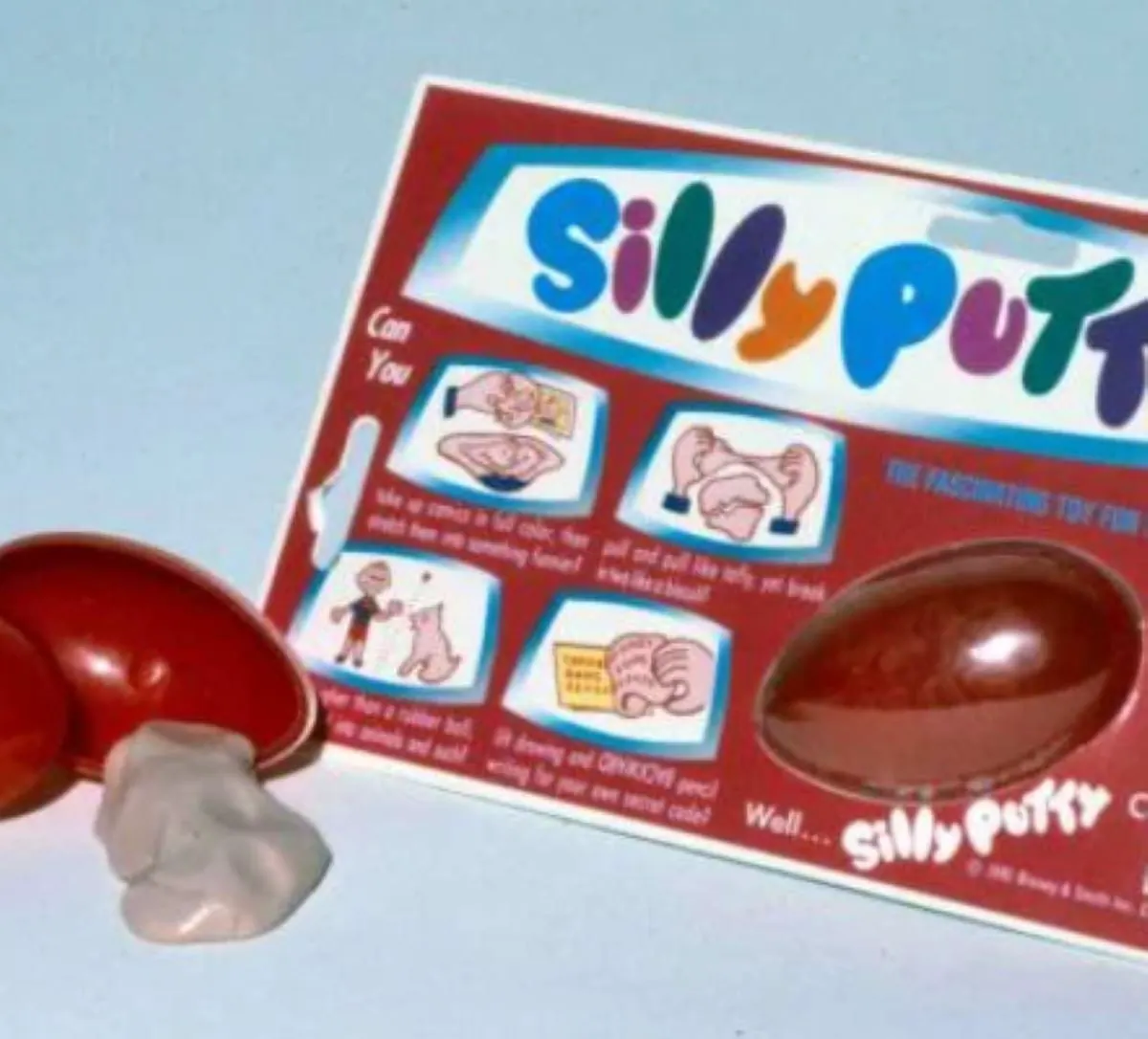
Silly Putty, a beloved toy, was initially developed as a synthetic rubber substitute for military tires, boots, and vehicle parts during World War II. General Electric engineer James Wright mixed silicone oil with boric acid to create a bizarre material that bounced higher than rubber, stretched incredibly thin without breaking, and snapped cleanly if hit hard. Although it lacked the structural strength needed for military applications, the material found a new life as a toy when Peter Hodgson, a toy consultant, packed it inside small plastic eggs and launched it as Silly Putty in 1949.
Listerine, a popular mouthwash, was initially formulated as a powerful surgical antiseptic in 1879 by Dr. Joseph Lawrence and chemist Jordan Wheat Lambert. The product was named after Sir Joseph Lister, a pioneer of modern antiseptic surgery. Initially marketed as a floor cleaner, a gonorrhea treatment, a cold remedy, and an aftershave lotion, Listerine struggled to find its place in the market. It wasn't until the 1920s, when the Lambert Pharmacal Company framed bad breath as a serious medical condition called "chronic halitosis," that Listerine became a huge success.
Kleenex, a well-known tissue brand, was initially developed as a soft, highly absorbent paper tissue during World War I by Kimberly-Clark. The military used it as a cheap substitute for surgical cotton and as a filtering material inside gas masks. After the war, the company refined the paper into thin sheets called "Kleenex Kerchiefs," designed for women to wipe away cold cream and makeup. However, customers began using the tissues to blow their noses, and Kimberly-Clark shifted their marketing strategy in 1930 to highlight Kleenex as a hygienic, throwaway alternative to cloth handkerchiefs.
Key points
- Many everyday products have found success after being repurposed for new markets.
- Companies like 3M, Kimberly-Clark, and Kutol Products have demonstrated the importance of adaptability in product development.
- The success of these products highlights the value of innovation and creative problem-solving in turning failures into opportunities.