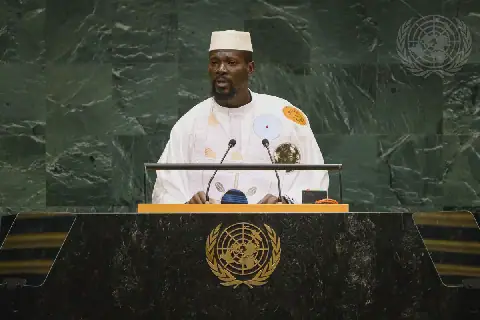
The 81st United Nations General Assembly opened on September 22 in New York, with heads of state and government succeeding each other at the podium. On the second day of the general debate, African countries such as Burundi, Libya, Botswana, the Central African Republic, and Ethiopia took their turns, expressing their concerns and national priorities. They also shared their vision of a more just and equitable world.
The UN General Assembly provides a platform for each state to express its views on the state of the world. However, it is clear that not all member states are treated equally. The speeches of some leaders, particularly Africans, were delivered to an almost empty hall, giving the impression that they were preaching to an empty desert. The UN platform seems to have become a place for diplomatic score-settling, with some leaders using it as a verbal boxing ring to exchange barbs.
Despite the eight decades that the UN General Assembly has been in session, the world still faces many challenges. Instability, divisions, and uncertainty persist, with multiple conflict zones around the world, including Ukraine, the Middle East, Sudan, Libya, the Democratic Republic of Congo, and the Sahel. The same inequalities and injustices persist, with the strong dominating the weak. The UN, created to prevent international conflicts and promote peace and security, seems powerless in the face of this violence and domination.
The UN Secretary-General, in his outgoing remarks, acknowledged that the organization was more necessary than ever in a world torn apart by conflicts. However, many question the organization's credibility and the influence of certain global powers that seem to manipulate it. The theme of this 81st General Assembly, focused on restoring trust, is justified. The UN must reinvent itself and adapt to its time, starting with giving Africa a rightful place within the organization, including a permanent seat on the Security Council.
The absence of permanent African representation on the UN Security Council is an anomaly that many voices have denounced. UN Secretary-General Antonio Guterres himself acknowledged that a 21st-century Security Council without African permanent representation is "unjust and indefensible." Africa accounts for over 60% of the Security Council's debates and operational mandates yet lacks a veto power.
Before demanding a permanent seat at the UN, Africa would benefit from speaking with one voice to make its presence felt within the organization. The African continent must unify its stance to push for reforms and obtain a permanent seat on the Security Council. This unity would enable Africa to make its voice heard and advocate for its interests effectively.
As the UN General Assembly continues, world leaders must reflect on the organization's role and its ability to address global challenges. The UN must demonstrate its relevance and effectiveness in promoting peace, security, and development. To achieve this, it must adapt to the changing world and address the concerns of all its member states, particularly those from Africa, which feel underrepresented and marginalized.
Key points
- The UN must give Africa a permanent seat on the Security Council to reflect its importance and involvement in global affairs.
- The UN General Assembly must move beyond verbal sparring and focus on finding concrete solutions to global challenges.
- Africa must speak with one voice to make its presence felt within the UN and push for reforms.