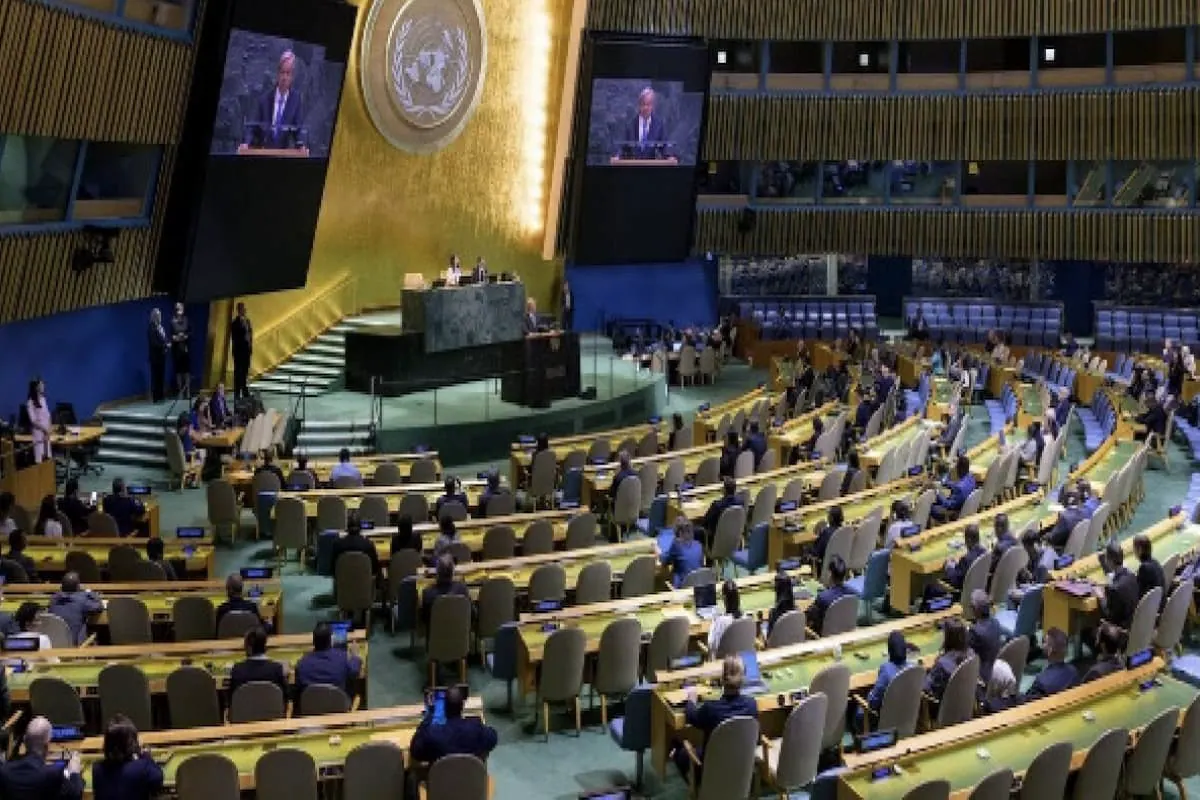
The 81st United Nations General Assembly began in New York on September 22, with the ongoing conflicts in the Middle East and Ukraine dominating the agenda. The situation in Gaza, humanitarian crises, and the risks associated with artificial intelligence were also key topics of discussion. According to UN Secretary-General António Guterres, the world is facing a period of deep uncertainty, with multiple challenges that require collective action.
Guterres identified four major challenges in his opening speech: war and peace, inequalities, climate change, and artificial intelligence. He called for strengthened international cooperation and reform of the Security Council, including permanent representation for Africa. The Secretary-General emphasized the need for the international community to work together to address these pressing issues.
The Middle East conflict was a major focus of the assembly, with the war between Israel and Palestine, as well as the situation in Gaza, being discussed by several leaders. Guterres urged the international community to allow the UN and humanitarian organizations to carry out their missions in the Palestinian territories. He also warned of the erosion of prospects for a two-state solution.
The conflict in Ukraine was another significant topic of discussion, with Guterres condemning Russia's invasion as a violation of the UN Charter. He called for continued diplomatic efforts to resolve the crisis. The tensions in the Korean Peninsula were also addressed, with Japanese Prime Minister Sanae Takaichi denouncing North Korea's nuclear and ballistic advancements.
For the first time, artificial intelligence occupied a significant place on the assembly's agenda. Countries are seeking to establish an international framework to regulate its development and use. Guterres considered AI to be one of the major challenges facing the international community, alongside climate change and inequalities.
In addition to official speeches, bilateral meetings held on the sidelines of the assembly were also a focus of attention. A meeting between US and Iranian officials illustrated this parallel diplomacy, as Washington and Tehran explored conditions for resuming dialogue. The high-level week also addressed climate change, development financing, and pandemic prevention.
The assembly took place in a context marked by the multiplication of crises, and it appeared as a space for diplomatic confrontation and search for cooperation mechanisms on issues that transcend national borders. The UN plans to hold meetings on climate action, the right to development, and the consequences of rising sea levels.
Key points
- The 81st UN General Assembly focused on global conflicts, tensions, and humanitarian crises.
- Artificial intelligence was a major topic of discussion for the first time.
- The assembly called for strengthened international cooperation and reform of the Security Council.