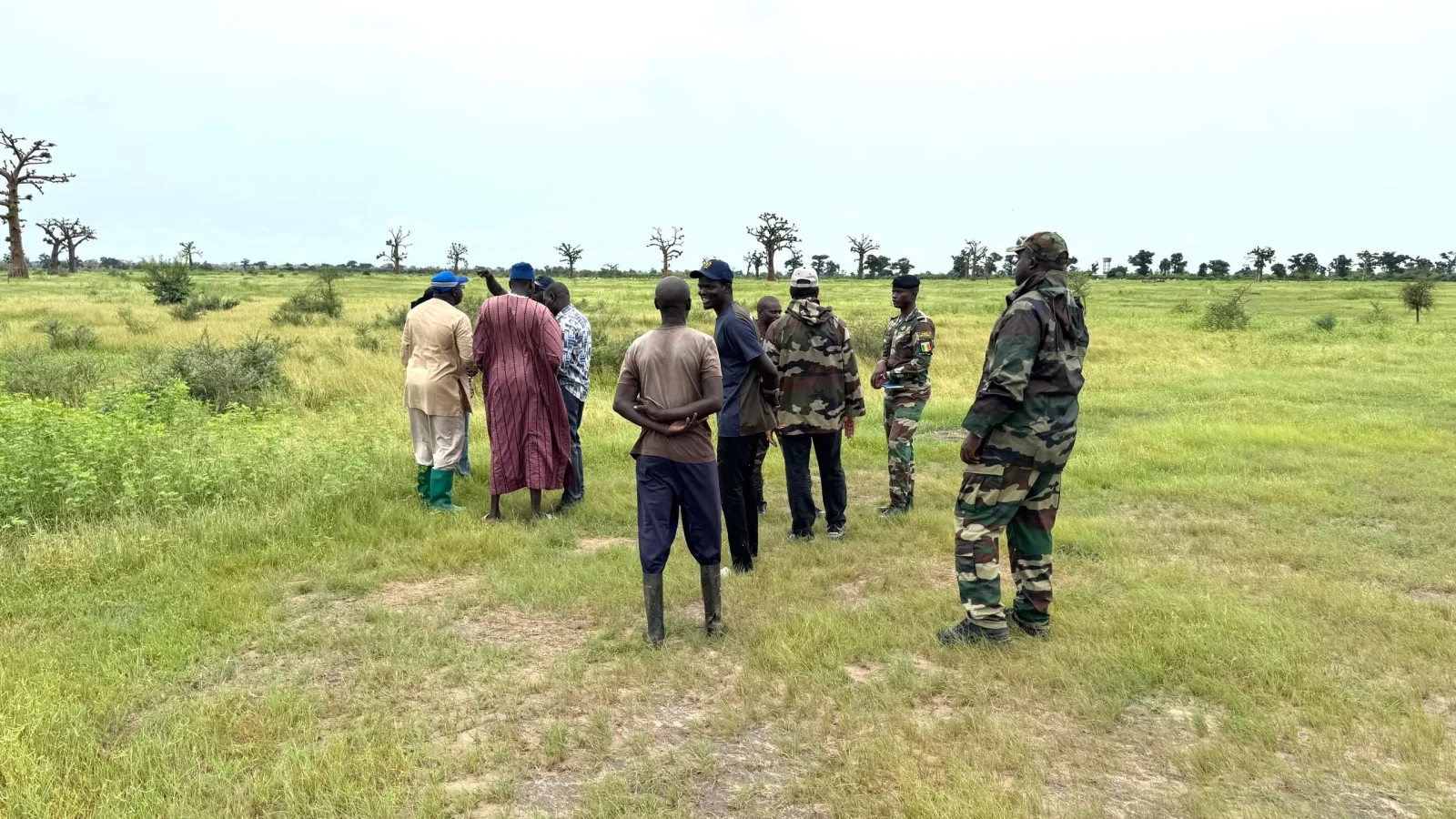
In Ndingler, a commune in the Thiès region of Senegal, a joint technical mission from the Ministry of Agriculture, Food Sovereignty, and Livestock (MASAE) and the Military Engineering Corps visited the site to prepare for the development of 80 hectares of land for 39 families. The goal is to transform the land into agricultural activity, generating income and economic opportunities for the concerned populations.
The project has made significant progress, particularly with Babacar Ngom's voluntary renunciation of the land title in January 2026, without any compensation. This decision paved the way for a new phase focused on the effective valorization of the land. The MASAE mission aims to achieve this goal by conducting a thorough reconnaissance of the 80 hectares to identify constraints and determine the necessary work to restore the land.
The technical teams, comprising representatives from the National Pedology Institute (INP), the National Agency for Agricultural and Rural Development (ANCAR), and the MASAE projects and programs, assessed the site to outline the required operations. These include clearing, stump removal, leveling, decompacting, and loosening the soil. The presence of the Military Engineering Corps will enable the evaluation of mechanized means necessary for heavy work.
Before any intervention, the physical and administrative securing of the perimeter is a priority. The precise delimitation of the 80 hectares, the materialization of boundaries, and the availability of a reliable cadastral plan will prevent future misunderstandings and secure the allocation of parcels to beneficiary families. This step will be followed by the actual development work, which will involve determining the necessary equipment, teams, deadlines, and logistical means.
However, sustainable cultivation will require complementary investments, particularly for perimeter protection with fencing and access to water. The realization of boreholes and a suitable water distribution network is envisaged to reduce dependence on rainfall and enable diversification of productions and more regular agricultural activity. The choice of crops will consider soil characteristics, water availability, and producer capacities.
Traditional rainfed crops, such as millet, peanuts, maize, and cowpeas, will constitute a first base. Vegetable gardening and certain livestock activities could complement the system when technical and economic conditions are met. Babacar Dionne, spokesperson for the village chief, welcomed this field approach, which will enable State services to directly assess needs and work with populations to resolve them.
The development of 80 hectares of land in Ndingler is expected to significantly improve the living conditions of 39 families. The project's success will depend on effective collaboration between the stakeholders, including the MASAE, the Military Engineering Corps, and the local populations. The project's impact will be closely monitored, and its outcomes will be crucial for the future of agricultural development in the region.
Key points
- The Senegalese government has launched a project to develop 80 hectares of land in Ndingler for 39 families.
- The project aims to transform the land into agricultural activity, generating income and economic opportunities for the concerned populations.
- The development of the land will require complementary investments, particularly for perimeter protection with fencing and access to water.