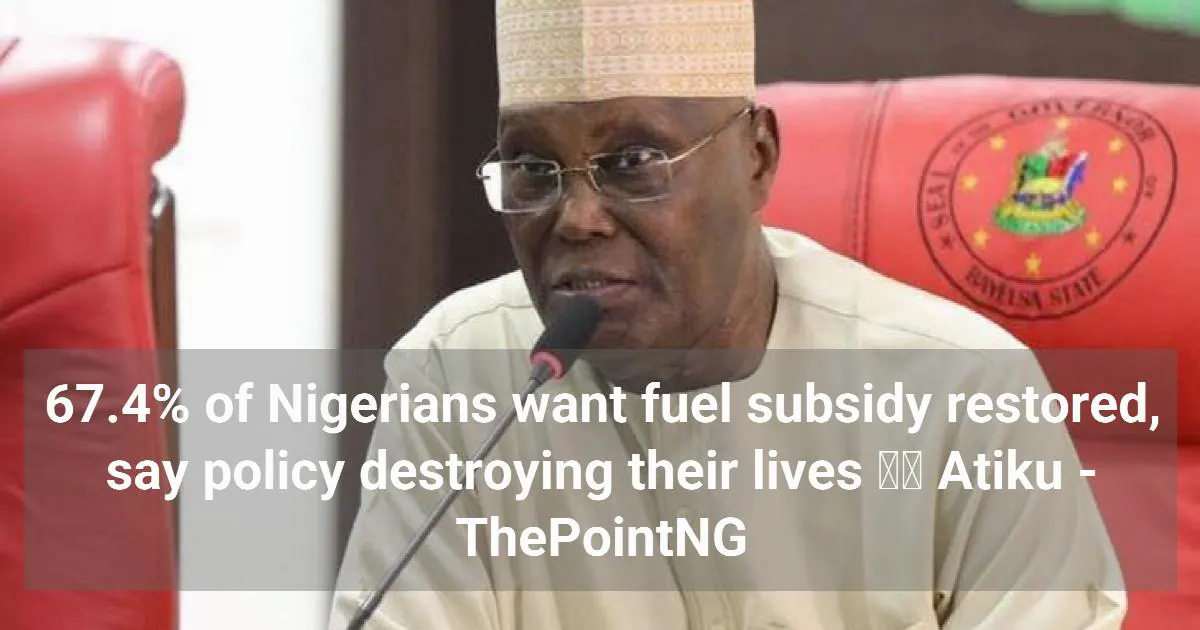
Former Vice President Atiku Abubakar has stated that a significant majority of Nigerians are in favor of restoring the fuel subsidy. According to a survey conducted by SBM Intelligence, 67.4% of Nigerians want the subsidy reinstated. Atiku cited this finding as evidence of the widespread demand for relief from rising fuel and transport costs. The survey results highlight the pressure faced by households, workers, and businesses due to increasing petrol prices.
The survey results were released by Atiku's Senior Special Assistant on Public Communication, Phrank Shaibu. Atiku emphasized that the issue is no longer just about economic policy but has become a democratic question. He stated that when a majority of Nigerians declare that a government policy is destroying their lives, responsible leadership must listen. The survey ranked petrol as the second-most cited national problem and the Tinubu administration's worst-rated policy issue, scoring 1.69 out of four.
The survey revealed that petrol is a bigger concern in rural areas, where 32.4% of respondents identified it as their primary problem, compared to 11.7% in urban areas. The issue ranked highest in the South-West, at 30.5%, and South-South, at 29.1%. Atiku attributed the hardship faced by Nigerians to the removal of the subsidy, which has led to increased transport and food costs, weakening household and business purchasing power.
Atiku criticized the removal of the subsidy, stating that it was done without a credible plan for domestic refining, mass transportation, wage protection, or support for small businesses that rely on affordable energy. He proposed an alternative solution, which involves introducing a transparent production subsidy for petroleum products refined in Nigeria and sold to Nigerians. This plan would not restore the old subsidy regime but aims to reduce fuel prices, strengthen domestic refining, and restore purchasing power.
Atiku's proposed subsidy scheme would have a fixed spending limit, require National Assembly approval, and undergo independent audits. He emphasized that imports would not qualify for the subsidy. The aim is to provide relief to Nigerians while ensuring a transparent and accountable system. Atiku's statement highlights the need for a more comprehensive approach to addressing the challenges faced by Nigerians due to the removal of the subsidy.
Atiku's proposal is part of his broader strategy to address the economic challenges faced by Nigerians. He stated that if elected, he would introduce the transparent production subsidy from May 29, 2027. The plan is designed to provide relief to households, workers, and businesses while promoting domestic refining and reducing fuel prices.
The issue of fuel subsidy removal has been a contentious topic in Nigeria, with many citizens expressing concerns about the impact on their livelihoods. Atiku's statement and proposal highlight the need for a more nuanced approach to addressing the challenges faced by Nigerians. The survey results and Atiku's proposal underscore the importance of considering the welfare of citizens when making policy decisions.
Key points
- 67.4% of Nigerians surveyed want petrol subsidy restored.
- Atiku proposes a transparent production subsidy for petroleum products refined in Nigeria.
- The removal of subsidy has led to increased transport and food costs, weakening household and business purchasing power.