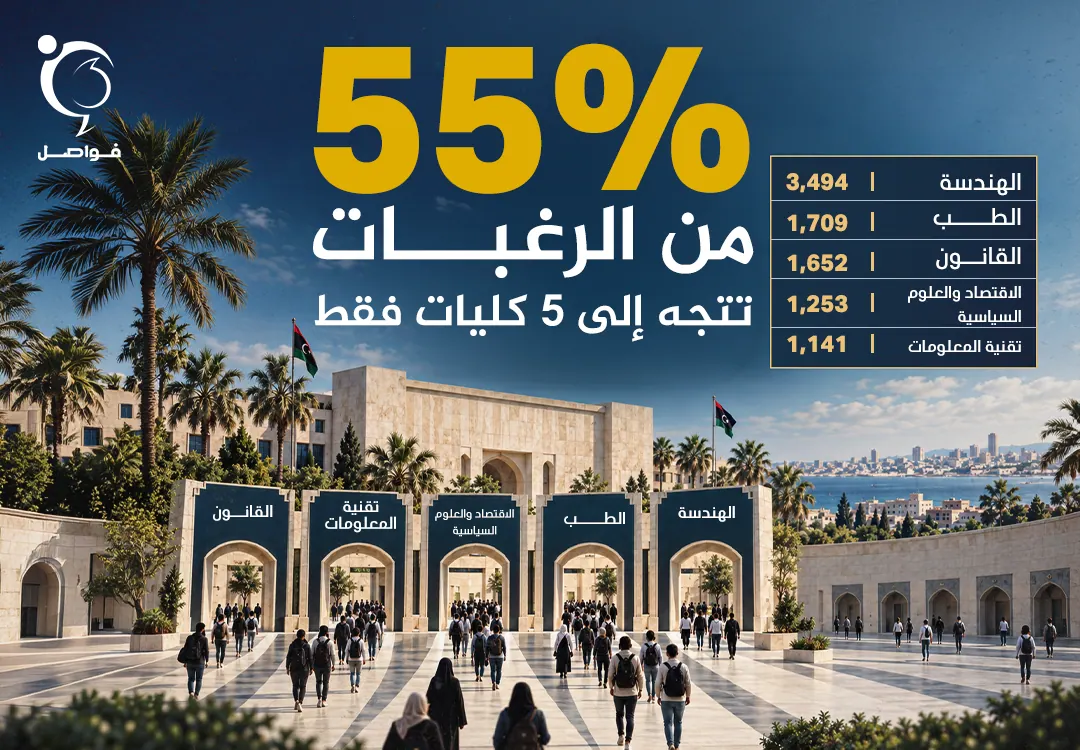
The University of Tripoli has received 16,737 applications for the upcoming academic year, with a significant majority of students expressing interest in just five colleges. According to the preliminary registration data, 55% of applicants are vying for spots in the top five colleges, with the College of Engineering leading the way with 3,494 applicants. This is followed by the College of Medicine with 1,709 applicants, the College of Law with 1,652, the College of Economics and Political Science with 1,253, and the College of Information Technology with 1,141 applicants.
In contrast, several colleges have attracted relatively few applicants, including the Colleges of Media, Communication, Agriculture, Nursing, Veterinary Medicine, Physical Education, and Islamic Studies, which together have only 277 applicants. This represents less than one-tenth of the number of students interested in the College of Engineering alone. The disparity in applicant numbers has raised questions about the factors driving student preferences and the capacity of the university to accommodate the large numbers of applicants.
The current academic year is notable for a significant increase in the high school pass rate, with 77.28% of students achieving a passing grade in the first round, up from 56.62% in the previous year. The pass rate for students in the scientific stream was even higher, at 79.87%. An analysis of the distribution of grades found that 66.9% of students received an excellent rating, rising to 71.2% among scientific stream students.
The University of Tripoli has responded to the changing landscape by adjusting its admissions policies. The university has maintained a preparatory year for students applying to medical fields, including human medicine, pharmacy, and dentistry, with a minimum grade requirement of 85%. For engineering and information technology, the minimum grade requirement is 75%, while admission to other colleges is direct, subject to each college's specific requirements.
Despite these efforts, the university faces challenges in accommodating the large number of applicants. The institution has acknowledged that its current capacity does not allow for the absorption of large numbers of students in a single intake. As a result, meeting the minimum grade requirement is not sufficient for some programs, with factors such as capacity and competition also playing a role in determining which students secure a place.
The concentration of applicants in a few colleges has sparked concerns about the potential for students to be redirected to other institutions or programs. The situation highlights the need for strategic planning and resource allocation to ensure that the university can provide high-quality education to all students, while also addressing the diverse needs and interests of the Libyan student population.
As the academic year begins, the University of Tripoli faces the challenge of balancing student demand with available resources. The institution must navigate the complexities of admissions, while also working to enhance its capacity and quality of education. The Libyan government and other stakeholders will be watching closely to see how the university addresses these challenges and supports the development of the country's future workforce.
Key points
- The University of Tripoli has received 16,737 applications, with 55% of students seeking spots in just five colleges.
- The College of Engineering has attracted the most applicants, with 3,494 students vying for spots.
- The university has adjusted its admissions policies to reflect changing student demand and capacity constraints.